Tuesday, April 09, 2013

Why negative political attack advertising fails - and why the BC Liberals are taking dangerous chances using it


Negative Advertising Fails  
Concerned Citizens for BC's extremely negative attack ad style
That's what research and British Columbia's experience shows

Bill Tieleman’s 24 Hours Vancouver/The Tyee column 

Tuesday April 9, 2013
By Bill Tieleman
"The research clearly shows that negative ads are not more persuasive than positive ads."
- Bill Benoit, Ohio University communication studies professor
New Democrat leader Adrian Dix is taking the biggest political risk of his life -- and his party will win or lose this election because of it.
No, it's not by promising well in advance that an NDP government would increase the corporate tax rates or put a minimum tax on banks and financial institutions nor is it an ill-advised policy in the party's forthcoming platform.
Dix rolled the dice a year ago when he publicly pledged the NDP will not run negative or personal attack ads, period.
The NDP has not and will not respond in kind to the vicious $1 million assault on Dix's own character launched by Concerned Citizens for BC, a BC Liberal-linked group led by Jim Shepard, an ex-Christy Clark advisor and former corporate CEO.
But is Dix being risky or is it really Clark's team taking dangerous chances by gambling everything on the success of negative advertising?
After all, the NDP is 20 points ahead of the BC Liberals and Dix's approval rating is miles ahead of Clark's, according to the last Angus Reid poll.
The focus on negative ads may be because while political operatives strongly believe negative advertising works, those who actually empirically study advertising for a living say the research tells a different story.
Confused consultants
"Everyone remembers the races where a negative attack or series of attacks appears to have been decisive. That's the kind of knowledge candidates and consultants have -- it's anecdotal evidence. The scholarly evidence doesn't back them up," says Stephen Craig, professor of political science at the University of Florida.
"Here's the deal -- why are there so many negative ads? Because candidates and consultants believe they work," Craig says.
"If you've got a powerful negative message that resonates with voters, then yeah, it's going to work. But if it's about something voters don't care about, if it's a message that's poorly presented, then they're not going to be moved by it."
"Can it work? Yes. Does it work? Sometimes," Craig sums up.
Another expert who has done the research says policy trumps so-called "character" issues time after time.
"It would seem that the candidate who talks more about policy may be more likely to win," says Bill Benoit, an Ohio University communication studies professor who studies negative political advertising.
"We found public opinion data from 1980 through 2000 where they asked voters what's the most important determinant of your vote for president and more people said policy or issues than character or image."
"So in fact, the candidates who talk more about policy are more likely to win than if you stress character," Benoit concludes.
Familiar weapon, new era
I know firsthand that negative advertising can work very well -- because I was Premier Glen Clark's communications director when our NDP campaign used it against then-opposition leader Gordon Campbell in 1996. And my colleague then was Clark's chief of staff, Adrian Dix.
The NDP launched a pre-emptive negative TV advertising strike against Campbell that started before Clark was even chosen leader in Feb. 1996.
Those ads, brilliantly created by NOW Communications, featured grainy black and white photos of a scary Campbell with an ominous deep male announcer's voice talking about BC Liberal plans to slash public services, then asking: "Gordon Campbell: Whose side is he on anyway?"
In the election campaign that followed, the NDP slogan was "On Your Side" and it was illustrated by the government freezing tuition fees, BC Ferries' fares, ICBC auto insurance rates and increasing the minimum wage.
All of that was counter posed to Campbell's agenda to cut 15 per cent from the BC budget, sell BC Rail, reduce the number of rural seats in the BC Legislature and generally shake up the province.
The BC Liberals ill-advised slogan -- "The Courage To Change" -- even reinforced the NDP message that bad things would happen if Campbell were elected.
The combination of heavy negative advertising against the BC Liberals – who initially held a 30-point lead -- and positive action by the NDP government combined to give Glen Clark a stunning upset victory.
'We need to bring people back to politics': Dix
Clark won more seats but fewer votes than Campbell's battered crew.
But the approach Dix takes to politics today has evolved since 1996.
"A lot of people think the way to respond to negative ads is to run negative ads ourselves," Dix told the Parksville Qualicum Beach news last May.
"The reason we are not going to do this is very simple. First, 1.7 million people didn't vote in the last provincial election.
"We are not going to bring anybody back to politics by deciding the winner of an election is the person with the best ad agency to run the nastiest negative ads. We need to bring people back to politics and that means offering some hope that change will happen," Dix argued.
And despite being the target of extensive personal attack ads, Dix has not wavered.
For their part, the BC Liberals surprisingly say they aren't going to go negative either.
Mike McDonald, the BC Liberal Party campaign director, claims his team is going to play nice.
"We're not going to run a nasty campaign," he told The Province's Michael Smyth.
"A campaign is where you debate. You talk about your strengths and your opponent's weaknesses. That's what we intend to do and we'll do it in a very fair, honest and factual way," McDonald says.
But even if McDonald is correct, he leaves unsaid the role of CC4BC and possibly other BC Liberal supporters running third party advertising.
Big turn-off
Regardless of that, other academic research should also concern the BC Liberals and their ad buying allies in CC4BC because it shows that increased repetition of negative advertising has the reverse effect on voters -- they are turned right off by it.
A new study out last month showed participants a series of ads, including negative political attack ads.
The study found that "after three exposures, participants had more favorable opinions of the candidate who sponsored the ad. But, after five airings, viewers' opinions became increasingly negative."
Juliana Fernandes, an assistant professor at the University of Miami in Florida who specializes in political communication, conducted the research and cautions that those using negative ads "should use negative ads strategically, not overwhelmingly."
Whoops -- that doesn't seem to have been the CC4BC approach with its carpet-bombing negative ad campaign.
But don't just blame political parties and advocacy groups for going negative – blame the media, says Benoit, who has extensively studied both American and international elections.
"We know that news coverage is always more negative than the candidates and the news coverage does not emphasize policy as much as the candidates do – the news focuses on horserace first and then character," Benoit argues persuasively.
Will Dix's boycott of negative advertising not only help the BC NDP win the election but also change the channel from nasty politics to policy?
If so, Dix will become the second B.C. opposition leader to easily win an election without running a single negative attack ad. Ironically the first was Gordon Campbell in his 2001 landslide victory over the NDP.
Disclosure: Tieleman supported Adrian Dix's NDP leadership bid.

.

Tuesday, April 02, 2013

BC Conservative leader John Cummins calls "inappropriate" Premier Christy Clark's meeting with ex-candidate Sukh Dhaliwal despite his facing six federal tax charges


Another Lapse in Christy Clark's judgment?
BC Liberal candidate Marvin Hunt, ex-candidate Sukh Dhaliwal, Premier Christy Clark at Laxmi Narayan Mandir Hindu temple in Surrey on March 26 - photo from temple Facebook page
NOTE:  Updated at end of column with response from Jaspal Atwal

Bill Tieleman’s 24 Hours/The Tyee column

Tuesday April 2, 2013

By Bill Tieleman

"Religion and political expediency go beautifully hand in hand."

- Friedrich Durrenmatt, Swiss author

Premier Christy Clark held an "inappropriate" meeting last week with a former BC Liberal candidate who faces six federal charges for failing to file corporate income tax returns, says BC Conservative Party leader John Cummins.
The Tyee has learned that Clark met on Tuesday, March 26 with Sukh Dhaliwal, who resigned his nomination in Surrey-Panorama February 8 after it was learned he faced charges filed in Federal Court on Oct. 15, 2012.
Cummins said Sunday that as premier, Clark should not meet with Dhaliwal because his charges are still unresolved.
'It's inappropriate'
"You shouldn't allow your office to be involved when someone is before the courts," Cummins said in an exclusive interview. "Prudence suggests that until that matter is resolved, the premier should not be involved -- it's inappropriate."
The charges have not been heard in court and thus are unproven allegations by the federal prosecutor.
The Tyee was alerted to photos on the Facebook page of Surrey's Laxmi Narayan Mandir Hindu temple showing Clark and Dhaliwal receiving blessings with Marvin Hunt, her new BC Liberal candidate in Surrey-Panorama.
The event seems to be a political appearance, with only BC Liberal candidates present and no New Democrat MLAs in the photos.
"You have to question the premier's judgment. That judgment is flawed, time after time," Cummins said. "There's just something that's not quite right about it.
Neither the BC Liberal Party, Dhaliwal or Hunt responded to Tyee requests for comment by deadline.
Sukh Dhaliwal, unknown person, Christy Clark, unknown person pose at temple March 26 - photo from temple Facebook page
Cummins noted an earlier controversy where convicted attempted murderer Jaspal Atwal was a replacement guest at the 2012 budget speech in the BC Legislature on a ticket from Premier Christy Clark¹s office.
BC Liberal Party executive member Tariq Ghuman resigned his position after taking responsibility for bringing Atwal -- who was convicted of shooting a visiting Indian cabinet minister in 1986 in a murder attempt -- to the Legislature.
And Dhaliwal has been in controversy before. In 2008, when serving as a federal Liberal Member of Parliament for Newton-North Delta, Dhaliwal sent an official letter supporting convicted international drug trafficker Ranjit Cheema to a United States judge, urging that Cheema be given a chance at rehabilitation.
Nonetheless, Cheema was sentenced to five years in jail for conspiracy to import 200 kilograms of heroin from Pakistan to North America. Cheema was killed in a drive-by shooting in May 2012 in East Vancouver.
Hunt backed by Dhaliwal
Surrey city councilor Hunt took over the nomination at Dhaliwal's urging, according to local media reports.
Dhaliwal was nominated as the BC Liberal candidate on Oct. 31, 2012 but claims that he only became aware of the charges laid Oct. 15 involving Genko Consultants Inc., where he is president and his wife Roni secretary, in late November.
Dhaliwal told media at the time he resigned in February of 2013 that he had been unaware of the income tax charges regarding his company, one of three he owns, and that his personal taxes were up to date.
Clark's willingness to take big political chances by being publicly seen with Dhaliwal is a clear sign that things are increasingly desperate for the party as the election nears.

UPDATE - Response from Jaspal Atwal 

I received this email from Jaspal Atwal today, as did 24 Hours Vancouver newspaper.

I disagree with his assertions below but he has every right to his opinion and I present it for your information:

From Jaspal Atwal:

I find it terribly hypocritical that BC Conservative Leader John Cummins says that Premier Christy Clark held an “inappropriate” meeting last week with former BC Liberal candidate Sukh Dhaliwal who faces six federal charges for failing to file corporate income tax returns.

Has Cummins very conveniently forgotten his own criminal record? 


While Dhaliwal is innocent until proven guilty (unless of course there is one standard for white guys and another for brown guys!), Cummins was actually convicted on SIX counts for “purchase, sell or possess illegally caught fish” in 2011.


Bill Tieleman in his column on Tuesday also unnecessarily dragged in my name for something that happened 26 years ago. He wrote: “BC Liberal Party executive member Tariq Ghuman resigned his position after taking responsibility for bringing Atwal – who was convicted of shooting avisiting Indian cabinet minister in 1986  to the legislature.” 


I have served my time and am carrying on legitimate business. Does that mean that I cannot ever participate in society?

Or is it because I am a brown guy while Tieleman and Cummins are white? 


Some time ago, when I confronted Cummins for having brought up my past and pointed out that he too was a convict, he had the decency to admit his mistake and apologized to me.

.

Sunday, March 31, 2013

The HST's grim toll continues in restaurant business even as it disappears

The Harmonized Sales Tax devastated restaurants across British Columbia since it was imposed - as it finally disappears on April 1, remember how many chefs, servers and other staff suffered the results of the extra 7% tax on meals.


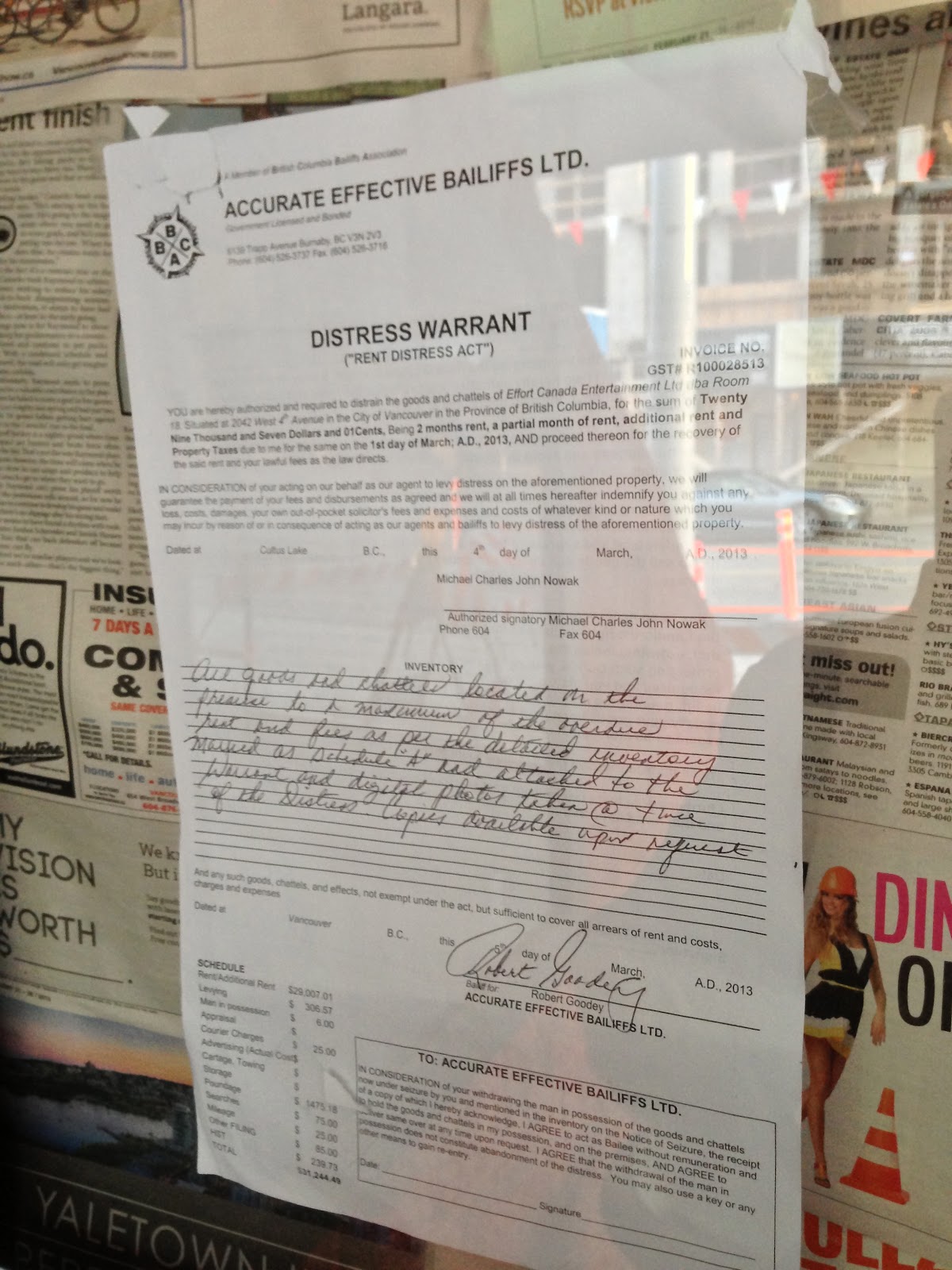
Hell's Kitchen bailiff notice

Room Eighteen bailiff notice

Room Eighteen

Hell's Kitchen 
I went for a walk this past week on 4th Avenue in Kitsilano and on just one city block found these two bailiff's notices on two prominent and now closed restaurants - Hell's Kitchen and Room Eighteen.

I do not claim the HST is responsible for their unfortunate closures but without question the HST has killed countless restaurants and jobs since it was imposed by the BC Liberal government in 2010.

You don't need to take my word for that - listen to Per Maltesen, owner of Nanaimo's New York Style Pizza & Pasta and chairman of the B.C. Restaurant and Foodservices Association


"The HST was the worst thing that has ever happened to this industry and it has directly resulted in putting a lot of restaurants out of business in this city and across the province," he said.

"The restaurant industry is the toughest business in the world and the introduction of the HST was the nail in the coffin for many. It's not that we were against the HST, just that this tax on food should never have been a part of it."

The BCFRA estimates restaurants have taken a 9% hit in sales since 2010.

So on April 1, celebrate the end of the HST by going out to breakfast, lunch or dinner at a local restaurant - and tell them you are there because the HST isn't!

.


Tuesday, March 26, 2013

HST Casts Long Shadow over May 14 BC Election

The Harmonized Sales Tax is officially dead, and so are the BC politics that spawned it.
Bill Tieleman and Bill Vander Zalm after HST Referendum win.
Bill Tieleman’s 24 Hours/The Tyee column

Tuesday March 26, 2013

By Bill Tieleman

"If Premier Gordon Campbell and the BC Liberal MLAs don't listen to the people and drop the HST, he and his party are finished." 


Three years to the day of that warning from Fight HST leader Bill Vander Zalm, the harmonized sales tax is finished, Gordon Campbell is finished and in six weeks most BC Liberal MLAs will be finished.

On April 1 the despised HST that shifted $2 billion a year in taxes from big business onto the back of consumers will finally disappear.

While an extra seven per cent tax was put on hundreds of services for consumers, businesses got massive tax credits -- paid for out of your pocket.

So killing the HST means seven per cent less tax on home renovations and repairs, domestic airline tickets, taxi fares, basic telephone and cable, massage therapy, vitamins and hundreds more items.

That tax shift doomed the HST even more than the underhanded way it was introduced.

Despite some repeated media claims it wasn't the HST that was the problem, but only the way the BC Liberals brought it in and communicated it, ex-premier Campbell's ex-chief of staff Martyn Brown disagrees.

In his new ebook "Towards a New Government In British Columbia," Brown clearly states what Fight HST argued all along about why voters were furious, from his perspective as Campbell's long-time top political staffer.

"They opposed it because it was so clearly a tax shift that took more money from their pockets to facilitate lower taxes for business, which might make businesses more competitive and profitable, but that also reduced working families' take-home pay," Brown wrote.

"...blaming the HST debacle on communications misses the point. And that is, the decision itself was wrong," Brown continues. "It was wrong because of the governing party's stated position against the HST, before and during the election, and because of its failure to earn social license for that tax shift before announcing it as a fait accompli."

"Most taxpayers did not believe it would make them better off. They believed it would do the opposite," Brown wrote.

Gordon Campbell has long exited both B.C. politics, and even the country, after the HST made him Canada's most disapproved premier, with just 12 per cent of British Columbians approving of his performance by Sept. 2010.

And after the May 14 provincial election, most BC Liberal MLAs who imposed the HST will also be history -- either afraid to run or likely defeated, with their party falling to just 28 per cent in the latest Angus Reid Public Opinion poll versus 48 per cent for the New Democrats.

And Brown also writes that BC Liberal MLAs "...woefully underestimated the political price they would pay for their personal support [for the HST]. For most government MLAs that day of reckoning has yet to come."

No more betrayals

But the HST will cast a shadow longer even than the election results.

No provincial politician, from B.C. Premier Christy Clark to NDP leader Adrian Dix to future premiers, can ever consider drastically betraying the trust of voters by reneging on campaign promises after an election.

It's extraordinarily difficult to achieve a citizens' Initiative petition to get 10 per cent of valid voters in every one of B.C.'s 85 ridings.

But the Fight HST campaign -- where I was strategist -- proves that government and big business advertising is no match for angry citizens and grassroots rebellion.

The 2011 binding referendum vote saw 55 per cent of British Columbians vote to kill the HSTversus 45 per cent wanting to keep it, despite an $8-million government ad campaign and a never disclosed but estimated $10 to $20 million ad campaign by the big business-funded Smart Tax Alliance.

No political party will ever think it can get away with an enormous double-cross on its own significant pledges -- and to even its own supporters.

Both the home building and restaurant industries saw the BC Liberals state that an HST was not being contemplated, in response to direct questions posed before the election, only to betray their political allies.

In fact, it was Brown himself who personally expressed the BC Liberal Party position that the HST was not contemplated, in his role as public campaign director in the 2009 election, writing that he was "utterly certain about that fact."

Some still believe that the HST was planned long before the election but my belief, supported by Brown's book, is that the BC Liberals panicked after the election when Campbell's promise that the provincial deficit would be no more than $495 million ballooned to an estimated $2.8 billion. It eventually came in at $1.8 billion -- still almost four times larger than promised.

A desperate Campbell and then-finance minister Colin Hansen frantically grasped at the HST and a federal Conservative government grant of $1.6 billion as the only way to save face and avoid the "fudge-it budget" they accused the NDP of in 1996 -- but with numbers 10 times worse!

Legacy of a 'fiasco'

Regardless of the timing, the results were clear.

As Brown rightly summarizes what the HST "fiasco" teaches all parties:

"The bottom line is this: if any government wants to do anything of the scale or importance of the HST, it needs clear, prior social license. Period. That was the main lesson from the HST debacle."

But if BC Liberals will pay the political price soon, it was ordinary consumers who paid the financial price for the past three years, with estimates on the average annual extra cost per household ranging from $350 to $2,000 or more.

That's because the HST not only was a $2-billion shift of taxes from businesses to individuals, it was also not "revenue neutral" as Campbell and Hansen repeatedly swore.

In fact, the government's own independent panel report -- long after imposing the HST -- found that it was raising an extra $820 million a year off consumers.

In the end, the HST legislation proved to be what NDP MLA Leonard Krog described as "the longest political suicide note in provincial history."

Those BC Liberal MLAs who supported the HST right to the bitter end, including Clark, will learn the true price of the HST on May 14.

NOTE:

Fight HST leader Bill Vander Zalm will be guest speaker at a Celebration of the end of the Harmonized Sales Tax in Victoria outside the BC Legislature  on Sunday March 31 at 1 p.m.  More details at: https://www.facebook.com/events/497090093687554/

And Vander Zalm will be interviewed on Wednesday March 27 from 7 to 8 p.m. on Have Your Say – an online radio show hosted by Fight HST activist Sal Vetro - http://blogtalkradio.com/bcpolitics

.

Monday, March 25, 2013

Is BC Liberal voter identification campaign on in Vancouver-Point Grey? Toronto firm Logit calling - here are all their questions

Are BC Liberals doing voter identification and polling in Vancouver-Point Grey riding through Toronto firm Logit?  Here are the questions being asked:

Who is Logit calling for in Vancouver-Point Grey riding?
A Toronto "telephone data collection" firm called Logit is calling extensively in Vancouver-Point Grey riding and I have all the questions being asked.

The likelihood is that they are working for the BC Liberal Party but Logit has not yet responded to my inquiries.  

It is possible that this is polling done by someone or as an Omnibus poll but who would poll in Vancouver-Point Grey other than a political party - and I have spoken to other people in the riding who have also been called.  

A poll in the riding would only need 300 respondents to be a decent sample so the odds are that it is voter identification used to determine campaign messaging and get out the vote efforts in the election.

Neither the NDP nor BC Conservatives are doing the calling.

I previously reported in January in 24 Hours newspaper and The Tyee on a province-wide "robo call" effort by another firm called Probit, a division of Ekos Research, that appeared to be doing voter identification also by calling every voter in BC!

And in the Vancouver-Point Grey by-election in 2011 I was also called and able to figure out what was going on.

I received a call from a live phoner saying they were with "University Research" on Wednesday March 20 from telephone number 1-416-640-3489.

That phone number is associated with Logit.

I know this because exactly the same number called me againThursday March 21 at 7:43 p.m. - as above - but this time on behalf of the Insurance Corporation of BC [ICBC] doing a customer satisfaction survey.

The Vancouver-Point Grey questions included:

Is British Columbia on the right track or wrong track?

Who would you vote for in the provincial election in Vancouver-Point Grey?

All major party candidates were listed, including BC Liberal Premier Christy Clark - it's her riding; BC NDP candidate David Eby - but Eby's name was mispronounced by the Toronto caller!,  BC Conservative candidate Duane Nickull and BC Greens candidate Francoise Raunet

Then I was asked what was the most important issue facing BC.

Next I was asked to rank the importance of 6 issues:  the economy; education; crime; healthcare; transit; and reducing oil tanker traffic in Burrard Inlet.

Then I was asked 6 more questions on whether I would be more likely or less likely to vote for any of the candidates if they supported these positions:


Selling the Jericho Lands [no explanantion given but presumably the federal armed forces base and related property] to improve infrastructure elsewhere.

Building a rapid transit line down Broadway.


Taking a strong stand against the federal government's closure of the Kitsilano Coast Guard Station.


Supporting a ban on more tankers in Burrard Inlet.


Blocking traffic on parts of Cornwall Avenue.


And which form of transit I believed should be built on Broadway:


A light rail line on the surface of Broadway - which the phoner said would take up some existing traffic lanes;


An underground bored subway tunnel, which the phoner said was more expensive than the other alternatives but less disruptive; or


A "cut and cover" tunnel [like the disastrous one done for the Canada Line on Cambie that drove small merchants out of business!], which the phoner said was cheaper but more disruptive.


Lastly I was asked age and education demographic questions.

All very interesting - especially the Jericho Lands question and the Broadway transit options.

.


Thursday, March 21, 2013

Thanks! From Bill Tieleman - I feel like a million - pageviews that is!

Thanks to all my readers for pushing this blog over the 1 million page views mark since May 2008!  
Cheers to all my blog readers!  And thanks!
Just a short thank you note to everyone who reads this blog - I was happy to discover that the number of page views since May 2008 has just gone past the 1 million mark!

Now, regular long-time readers will know that I started this blog in October 2006 - and I don't know why Blogger doesn't count all the page views between then and May 2008 - because with the coverage that was featured here on the Basi-Virk/BC Legislature Raid case there were a lot of readers before May 2008 - but what the heck - a million is a million!

Since May 2008 I have also posted 1121 different articles here - and well over 200 before that.

This is a blog run solely by me, I don't run ads to promote it and I rely on word of mouth and my columns in 24 Hours Vancouver newspaper and The Tyee online magazine to gain an audience.

So thank you again and stay tuned - perhaps I can hit the 2 million mark a lot sooner!  

.