Thursday, August 11, 2016

BC NDP Premier Glen Clark's Stunning 1996 Upset Victory and Lessons for Today's NDP

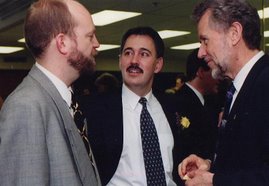
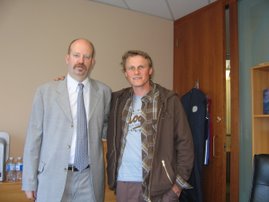
Bill Tieleman, Premier Glen Clark and Minister John Cashore - 1996
Yes, Gordon Campbell choked. Here's how the NDP helped him do it.

Bill Tieleman’s 24 Hours Vancouver / The Tyee column

Tuesday May 31, 2016

By Bill Tieleman

"Was that close or what?"

- Then-BC NDP premier Glen Clark, election night May 28, 1996

It was 20 years ago last Saturday that BC New Democrat Premier Glen Clark scored an amazing come from behind upset victory over then-BC Liberal leader Gordon Campbell -- but the lessons of that 1996 campaign are remarkably valid for the 2017 election.

Clark had taken over from NDP Premier Mike Harcourt in February 1996, with Campbell up to 30 per cent ahead in the polls -- and cruising towards an easy win.

But the scrappy, determined Clark wasn't conceding anything and launched an aggressive, comprehensive attack on Campbell and his policies that left the BC Liberals stunned when the votes were counted and they lost.

And bitter, as they got more votes than the NDP but won just 33 seats to Clark's 39, with the Reform Party taking two and the Progressive Democratic Alliance one.

There are several lessons from that historic campaign to be learned for the current opposition BC NDP under leader John Horgan with under a year until 2017's election.

And as Clark's communications director in 1996, I see some distinct similarities.

First, define your opponent.

Clark ran under the banner of "On Your Side" -- a populist appeal backed up by action.

He froze taxes, post-secondary tuition, BC Hydro and ICBC rates while increasing the minimum wage.

At the same time, Clark asked: "Whose side is Gordon Campbell on?"

The answer was spelled out in tough NDP TV attack ads created by NOW Communications, with a sinister Campbell in grainy black and white photos and ominous "voice of doom" narration.

Campbell allowed himself to be tattooed as an uncaring big business apologist who would slash public services with abandon, privatize crown corporations and govern as a city slicker who didn't get rural voters, having even promised to reduce representation in the Legislature.

The BC NDP must now negatively define Premier Christy Clark -- and she has lately been giving them plenty of assistance, with policies that hurt the disabled while she helps herself to an extra $50,000 a year from her party.

Second, it doesn't matter how narrowly you win seats.

The first past the post electoral system is not a province-wide election where voters directly chose the premier; it is 85 separate mini-elections for local representation and the party that takes a majority of those ridings forms government.

Winning big majorities in some ridings means no more than winning by tiny margins in others because each has just one MLA. It's the number of MLAs each party wins that counts.

So winning by just hundreds or even dozens of votes in a few ridings is essential to provincial election victories.

As Norman Ruff pointed out in a 1996 BC Studies article, had the NDP lost less than 1,000 votes to the BC Liberals, the Clark government would have been defeated. Was that close or what, indeed!

And as Ruff added, the BC Liberals: "learned on 28 May, the electoral system often gives an edge to regional concentrations."

That means in 2017 the NDP must again pursue an extremely strategic campaign where it focuses resources on winning close riding votes where they have regional strength and ensuring their platform appeals to local voters.

Third, campaigns matter greatly.

We have repeatedly seen that in both the last federal election and the 2013 BC contest where a front running NDP faded in the final stretch.

The 1996 BC NDP campaign ran flawlessly, with a mix of both positive platform announcements and negative hits on Campbell and BC Liberal promises, turning their possible win into a nightmare scenario for enough voters to win.

By contrast, the BC Liberal campaign was both nasty and ineffective. Their attacks on Clark as "Glenocchio" -- with a wooden nose growing over claimed broken promises was an American-style attack ad that jarred but didn't convince, turning off many voters.

Then Campbell was sidelined with a campaign scandal in the crucial final week when the Social Credit Party alleged it was offered a deal by the BC Liberals where the Socreds would pull all but one candidate and support Campbell in exchange for their leader not being opposed by a BC Liberal in his riding.

The strange deal gained credence when it was admitted two senior BC Liberals, including Campbell's campaign manager, had met the Socreds.

And though the deal was denied, Campbell fired no one and the controversy pulled the BC Liberals way off message and onto the defensive at the critical end game where voters decide -- with politically disastrous results.

Don't choke

Overall, the BC Liberals had many advantages they squandered -- a new leader without the baggage of time in provincial office; an opponent that had made many controversial decisions and dealt with several scandals in government; and a well-funded campaign that could have devastated the BC NDP but didn't.

As Norman Ruff noted: "The 1996 election campaign was unusual in that it made the opposition platform, rather than government performance, the main target for debate."

If the BC NDP are to win the 2017 election they have to take the 1996 lessons to heart and make sure as opposition they focus -- and don't choke like Campbell did back then.


.

Why Do So Many BC Liberal Operatives End Up in Trouble?

Brian Bonney - ex-BC Liberal government communications director
Laura Miller - BC Liberal Party Executive Director
Criminal charges, convictions, and more plague the BC Liberal Party. Why the pattern?

Bill Tieleman’s 24 Hours Vancouver / The Tyee column

Tuesday May 24, 2016

By Bill Tieleman

"Power does not corrupt. Fear corrupts... perhaps the fear of a loss of power."

- John Steinbeck, author 1902-1968

Why do so many BC Liberal operatives currently face criminal charges?

And why have so many other BC Liberals been convicted, disciplined, forced to resign, fired or otherwise criticized for breaking the law, violating rules or misbehaving?

With a criminal charge being laid last week against former BC Liberal government communications director Brian Bonney, and with two other party operatives already facing trials, those are questions that need to be asked of Premier Christy Clark.

Of course, everyone facing charges has the right to be presumed innocent and have their day in court, because allegations are unproven.

But nonetheless, the answer to the cause of the BC Liberals' legal problems could be disturbing.

Some may thoughtlessly say it's simply that the party attracts the wrong people, those without a moral compass. Others may think politics is endemically infected with bad apples.

But a more compelling analysis starts with looking at the nature of the charges, convictions and rule-breaking that have happened or is alleged to have taken place.

BC Liberal operatives have run into problems in mainly a few areas: breach of trust, election financing and deletion of government records.

The most common allegation is breach of trust, a Criminal Code violation with potentially serious consequences upon conviction -- up to five years in jail.

Bonney faces one breach of trust charge, and though a temporary publication ban has prevented media from reporting what happened in court last Tuesday, he and another ex-BC Liberal Party staffer -- Mark Robertson -- both had faced Election Act charges along with their company over the "Quick Wins" scandal where government resources were improperly used to court ethnic community votes.

Last week those earlier charges were dropped, but Bonney and Robertson's firm Mainland Communications pleaded guilty and was fined $5,000.

Bonney and Robertson were originally charged with making "an unauthorized election expense" for providing the services of campaign worker Sepideh Sarrafpour in the Port Moody 2012 byelection without informing candidate Dennis Marsden's financial agent, a violation of the Election Act.

Sarrafpour's story was disturbing when she subsequently went public, telling The Tyee: "I was going through hardship, really. I was almost for one year jobless, boycotted and blacklisted by Liberals."

The BC Liberal Party repaid $70,000 to the province for time Bonney spent improperly doing partisan work at public expense and fired him. And Clark's deputy chief of staff Kim Haakstad was fired, while other staff members were reprimanded for breaching the public service code of conduct.

Two operatives facing charges

Meanwhile, BC Liberal Party executive director Laura Miller was also charged in December with breach of trust but in Ontario, for actions that police allege she took to delete government records on the gas plant closure scandal in that province, when she was deputy chief of staff to then-premier Dalton McGuinty.

Miller initially resigned her BC Liberal top job but was recently rehired, with Clark calling her a "person of integrity."

Miller has vowed to exonerate herself after accusing the Ontario Provincial Police of bias and saying the charging process lacked "impartiality and fairness" because of a complaint she filed with the Ontario Independent Police Review Director.

Cabinet minister Rich Coleman defended Miller's re-hire, saying the charges were "a pretty old case" and that: "Our issue was, is she qualified to do the job? People still want her to be here."

And then there is George Gretes, the ex-ministerial assistant of Transportation Minister Todd Stone who was forced to resign and charged with lying under oath to the freedom of information commissioner over allegations he "triple deleted" government information sought in an FOI request related to the murder and disappearance of aboriginal women on northern B.C.'s Highway of Tears.

Disturbingly, Tim Duncan, the former staffer who blew the whistle on Gretes, said that some government officials attempted to make him out to be the bad guy.

"They had accused me of lying, essentially. I'm telling the truth to the commission and everybody else is saying he's a disgruntled employee, he's lying, he's trying to make us look bad," Duncan told CKNW Radio earlier this year.

"Any employer I ever apply to for another job will read that, and had that been allowed to stand, I mean, you are totally wrecking not only my ability to get another job, you are just totally wrecking me," Duncan said.

Wait, there's more

Going further back, the checkered BC Liberal record includes Election Act violations in 2009 when then-Liberal MLA Kash Heed's campaign was found to have overspent campaign limits. The former solicitor general was fined about $8,000, but allowed to keep his seat.

Heed said he was unaware of excess spending, and his campaign manager Barinder Sall pled guilty to Election Act violations, receiving a $15,000 fine and one year's probation -- but not before he alleged that up to $40,000 might have been improperly spent. No further charges were laid.

And the biggest breach of trust case of all was the BC Legislature Raid case, where after nearly seven years of claiming innocence, former BC Liberal ministerial aides Dave Basi and Bob Virk made a sudden guilty plea over charges they accepted benefits for providing confidential government information about the $1-billion privatization of BC Rail to lobbyists for one of the bidders.

The lobbyists, one a prominent BC Liberal, were not charged and cooperated with the police investigation.

Regardless of guilt or innocence, it's clear that improperly funding election campaigns -- occasionally with taxpayer dollars -- and either providing confidential government information or deleting it led to BC Liberal problems, charges and sometimes convictions.

Fear of losing power lies behind most of these actions -- and while scandals don't generally defeat governments, when the sheer weight of allegations reaches this level, it can go beyond scandal to character and integrity, an issue in every election.


.