Saturday, September 07, 2013

Spot the Political Weasel Words - how cliches keep politicians and reporters in business


Keep elected officials and journalists that cover them honest. Call out these slippery lines and clichés.

"Write this down.....one game at a time."
Bill Tieleman’s 24 Hours Vancouver/The Tyee column

Tuesday August 20, 2013

By Bill Tieleman

Crash Davis: "You're gonna have to learn your clichés. You're gonna have to study them, you're gonna have to know them. They're your friends. Write this down: 'We gotta play it one day at a time.'"
Ebby Calvin LaLoosh: "Got to play... it's pretty boring."
Crash Davis: "'Course it's boring, that's the point. Write it down."
- Bull Durham, 1988
Ever heard awful, boring, clichéd words coming from the mouths of politicians and journalists?
Of course you have -- practically daily if you watch television news and political panels!
Even the revered Peter Mansbridge, veteran anchor of CBC's The National, will regularly throw out one of the laziest questions in the media lexicon: "What do you make of this?"
Well, I make that it's a classic cliché that abdicates the interview entirely to the person asked. But it's hardly the only terrible turn of phrase.
For example, has any cabinet minister in recent memory "resigned" because of their role in something gone wrong? No. Instead we hear weasel words like this, after the BC Liberal ethnic outreach scandal earlier this year:
"When mistakes occur, and they do, we must confront them and take responsibility for them. I've talked to [John Yap], and he has agreed that he is going to step aside from cabinet," Premier Christy Clark told media in March.
"Step aside?" Is he square dancing? Will he step back inside shortly? No, Yap resigned, but don't expect the truth to be told. Unless, of course, a politician is desperately trying to sound sincere in interviews.
"To tell you the truth" and "to be honest" or "to be frank" are other classics -- because isn't the politician already supposed to be telling the truth?
B.C. Deputy Premier Rich Coleman is a master, getting two clichés into one short sentence.
"I think, quite frankly, the proponent here didn't do a great job of that, to be honest with you," Coleman said in 2011 while referring to a proposed mine.
No one is immune
Other annoying pseudo-aphorisms include the catchphrase "but at the end of the day," a signal that after blathering on for ages, a politician or journalist is about to finally, mercifully come to some conclusion that often contradicts what they've previously said.
No less an admired columnist as Chantal Hébert is not immune to using a cliché as a journalistic crutch. Writing on federal Conservative challenges in June, Hébert uncorked this one in the Toronto Star.
"With ongoing investigations into Senate spending, the upper house will almost certainly continue to give the government more than its share of headaches between now and the 2015 election," Hébert wrote.
"But at the end of the day it is the abrupt loss of a chief of staff with a central role in the operations of the government that falls in the potentially more lethal category of political injuries," she concluded, cliché confirmed.
Of course, if you are constantly concocting clichés there's only one thing to do -- promise to end the practice "on a go forward basis"!
Otherwise, to be honest, at the end of the day, you may have to step aside.

.

Tuesday, August 13, 2013

Accused's Lawyer Believes BC Legislature Bomb Plot Involved RCMP “Mr. Big” Sting


Questions mount after alleged "self-radicalized" bomb plotters John Nuttall and Amanda Korody's recent court appearance 
Lawyer Tom Morino outside BC Supreme Court August 7 - Bill Tieleman photo
Bill Tieleman’s 24 Hours Vancouver / The Tyee column

Tuesday August 13, 2013
By Bill Tieleman
"I think it's fair to say yes, this involved undercover, Mr. Big type covert operations." 
- Tom Morino, lawyer for B.C. Legislature bomb plot accused John Nuttall
Did you know that the Royal Canadian Mounted Police has a target of six disruptions of "terrorist criminal activities" this fiscal year?
No doubt one of those six disruptions happened when the RCMP arrested John Nuttall and Amanda Korody on charges of plotting to explode pressure-cooker bombs outside the B.C. Legislature on July 1 during Canada Day celebrations.
But after Nuttall and Korody's B.C. Supreme Court appearance last Wednesday, Aug. 7 before Justice Jeanne Watchuk, questions about the case continue to mount.
One query: how much pressure is the RCMP under to meet their terrorist targets as the federal Conservative government looks to reduce police expenditures?
Another question came when Nuttall's lawyer Tom Morino said after the short hearing was adjourned to Sept. 20 that while he has only received limited prosecution disclosure about the case against his client, it's enough for him to conclude the RCMP used "Mr. Big" tactics against Nuttall.
"Having seen Mr. Big cases, nothing in the [preliminary] disclosure surprised me," Morino told this reporter.
"We've received preliminary disclosure -- an executive summary I'd describe it as," Morino said. "We'll have full disclosure before the next appearance. I would anticipate thousands of pages of disclosure."
Strange court appearance
The controversial "Mr. Big" approach pioneered by B.C. RCMP undercover officers in the early 1990s involves police posing as criminals to gain suspects' confidence and collect evidence against them.
The tactic is seen as coercive and not allowed in Britain and the United States.
Yet more issues surfaced when Nuttall was sent to the Forensic Psychiatric Hospital in Coquitlam in late July.
"The only reason I'm aware that he has been certified under the Mental Health Act is because my client called me and told me," Morino said outside court.
"In my opinion, there's a sufficient nexus in time between this certification and the alleged incidents that it certainly raises the spectre of NCRMD (not criminally responsible by reason of mental disorder) -- or as we used to call it, 'insanity,''' Morino said.
Both Nuttall and Korody were taking methadone to reduce withdrawal symptoms from narcotics like heroin while living in poverty in a Surrey basement apartment when arrested.
In court Aug. 7, Nuttall looked more like an Amish farmer, with a dark beard and shaggy, shoulder length hair, than a suspected terrorist.
Nuttall turned to the courtroom full of media and gave what could only be described as a goofy grin out of place with the serious charges. He and Korody exchanged wide smiles, clearly pleased to see each other but again seemingly oblivious to their dire circumstances.
Why is RCMP so confident?
So how did two apparently hapless recent converts to Islam allegedly mastermind a plot to kill and injure hundreds of people in Victoria?
How were they "self-radicalized" and inspired by "al-Qaeda ideology" as RCMP claim, and did undercover officers or informants play a role in aiding their alleged bomb-making plot?
"In order to ensure public safety, we employed a variety of complex investigative and covert techniques to control any opportunity the suspects had to commit harm," RCMP assistant commissioner Wayne Rideout said in a July 2 statement announcing the arrests.
"These devices were completely under our control, they were inert, and at no time represented a threat to public safety," Rideout said then, but did not detail how that occurred.
The BC Civil Liberties Association has also raised concerns about the role of a possible "Mr. Big" police operation.
"The question is, how could the police be so confident that the explosive devices wouldn't work?" says Michael Vonn of the BCCLA.
"The surmise is they knew that because they either provided or provided portions of them, or somehow had been actively involved with the accused in developing or facilitating the alleged plot," she said.
Several American cases of terrorist activities have drawn charges of entrapment by defence lawyers.
In the case of James Cromitie, a Walmart employee tempted by a well-paid FBI informant offering $250,000 and a new BMW in exchange for firing missiles at U.S. warplanes and bombing Jewish targets in New York, a federal judge chastised the FBI.
"Only the government could have made a 'terrorist' out of Mr. Cromitie, whose buffoonery is positively Shakespearean in its scope," Judge Colleen McMahon said, while still sentencing him to 25 years in jail.
Trial expected in 2015
Morino said what was expected to be a bail hearing for Nuttall on Aug. 7 will instead take place at some later date.
"We can conduct a bail hearing whenever we wish. But until such time as I have some sort of reasonable proposed release plan in place, it's really a waste of time," he said.
Korody has now retained lawyer Mark Jette to represent her. Jette, who has previously acted for jailed gangster Jarrod Bacon and his parents in separate cases, was not in court Aug. 7.
Morino says a judge and jury trial is a long way off.
"I don't expect trial dates until 2015," he said.
So the B.C. Legislature bomb plot mystery continues, as does the RCMP's goal of disrupting more terrorist activities before the next fiscal year.

.

Tuesday, August 06, 2013

A Chance to Decriminalize Marijuana in BC With Sensible BC Citizens Initiative Campaign


Simple marijuana possession charges have doubled in BC since 2005 - it's time to stop the persecution

Sensible BC graphic shows dramatic increase in charges
"Penalties against possession of a drug should not be more damaging to an individual than the use of the drug itself; and where they are, they should be changed. Nowhere is this more clear than in the laws against possession of marijuana in private for personal use."

- US President Jimmy Carter, Aug. 2, 1977
It simply makes no sense that thousands of British Columbians face a criminal record each year for simple possession of marijuana.
And it's even crazier that the number of cannabis drug offences reported by police in B.C. jumped from 11,952 in 2002 to 16,578 in 2011.
These government statistics mean that even as marijuana has become increasingly socially acceptable, more people are being arrested in B.C., charged with cannabis possession offences and getting criminal records.
Amazingly, this province has seen marijuana possession charges more than double between 2005 and 2011, from 1,787 charges to 3,774.
Those charged don't include marijuana dealers, importers, exporters or growers -- just people found with small amounts of cannabis for personal use.
It's time to follow the example of Colorado and Washington state and end the persecution by supporting a B.C. citizens' initiative to decriminalize marijuana.
But the Sensible BC campaign that starts Sept. 9 won't succeed if British Columbians -- who polls show overwhelmingly support decriminalization -- don't get involved and force politicians to act.
A difficult task ahead
Sensible BC director Dana Larsen said in a Friday interview he is optimistic about their chances but strongly urged those who agree to volunteer as canvassers.
"The odds are way better now than when we started," Larsen said. "We have 600 canvassers signed up in the first few weeks but we need more."
A successful initiative requires the signatures of 10 per cent of registered voters in each of B.C.'s 85 ridings in 90 days -- about 312,000 in total.
"The odds are way better now than when we started," Larsen said. "We have 600 canvassers signed up in the first few weeks but we need more."
Larsen is counting on some of the 56,000 Facebook friends Sensible BC has to go out canvassing and is calling B.C.'s 1.4 million landlines twice to find supporters, as well as working a 17,000-person email list.
But the province's initiative process is extremely challenging. Only Fight HST's initiative has succeeded since initiatives were introduced in 1995.
Larsen said that big cities present the toughest obstacle.
"I feel better about the rural areas -- we really have to grow in the densely populated urban areas like Surrey and Vancouver," he said, because voters must sign the petition for their own riding only or they are disqualified.
Sensible BC has already succeeded in other ways, Larsen pointed out.
"We've shifted the debate from the federal government to what the B.C. government can legally do," he said, adding: "The Washington and Colorado marijuana referenda passing are huge."
Larsen confident of victory
And Larsen points out those who doubt Sensible BC's proposal can work that B.C. has effectively decriminalized a surprising list of things before, despite federal opposition: ownership of unregistered long guns; injection drug use at Vancouver's Insite and impaired driving.
The provincial government simply stopped enforcing the Long Gun Registry before the Conservative government abolished it; it won court battles against the Conservatives when they tried to terminate the Insite safe injection; and it toughened drinking and driving laws but moved the majority of charges to B.C. laws outside of the Criminal Code of Canada.
Sensible BC also notes that Elections BC has approved the initiative's proposed legislation to decriminalize marijuana.
"Elections BC rejected the first four drafts of our legislation," Larsen said. "They've said it's now legal. At $50 per application, it's the cheapest legal advice available!"
That is partly why Larsen says B.C. can decriminalize marijuana possession by simply ordering police not to enforce the law.
Unfortunately, the opposite is happening right now, with marijuana possession arrests up significantly since Stephen Harper's Conservative government took power in 2006. And that's despite Vancouver police reducing the city's number of charges.
But Larsen is confident of eventual victory, pointing out that polling shows that even 57 per cent of Conservative voters support decriminalization.
Marijuana will be decriminalized in British Columbia -- but it could happen a lot sooner if enough citizens support the Sensible BC campaign and sign the initiative petition.

.

Wednesday, July 31, 2013

Bill Vander Zalm's new book on Fight HST campaign gives valuable lessons to marijuana citizens' Initiative campaign and others

For Marijuana Campaigners, Lessons from Fight HST's Playbook - in Bill Vander Zalm's book HST & The People for Democracy
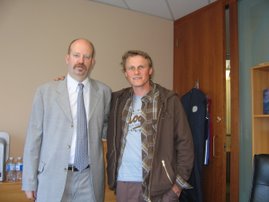
Lillian and Bill Vander Zalm, Bill Tieleman at Fight HST campaign launch, September 19, 2009

Vander Zalm's chronicle of BC's anti-tax initiative is a citizen changemaker's must-read

Bill Tieleman’s 24 Hours Vancouver / The Tyee column
Tuesday July 30, 2013
By Bill Tieleman
"Some government will have to improve the initiative process to make it more democratic." 

- former B.C. premier Bill Vander Zalm 
If organizers for the upcoming Sensible BC campaign to decriminalize simple marijuana possession want to succeed, they should turn to the man who wrote the book on winning a Citizen's Initiative -- literally.
Bill Vander Zalm has just published HST & The People for Democracy -- a 180-page book outlining how Fight HST launched the only successful Citizen's Initiative process since the legislation was passed in 1995, eventually killing the Harmonized Sales Tax in British Columbia.
And as Sensible BC canvassers hit the streets starting Sept. 9, the lessons learned from Fight HST offer some hope of victory.
The challenge is daunting, as I well know -- because I helped create Fight HST with Vander Zalm and others back in 2009 to oppose the tax brought in by ex-BC Liberal premier Gordon Campbell.
How hard is it? You have to get the signatures of 10 per cent of registered voters in every one of B.C.'s 85 ridings in just 90 days, about 312,000 in total.
That means signing up 3,500 voters every single day -- and if you miss just one riding, you lose.
But Vander Zalm proved it could be done against all odds, and his book outlines the extraordinary difficulties an Initiative faces, and how they were met.
"The reason I wrote the book is because I feared that five years from now people might have forgotten the fight for democracy," Vander Zalm told me Saturday. "It's also a how-to book for other Citizen's Initiatives."
HOW TO BUY THE BOOK
You can purchase HST & The People for Democracy for $20 -- including GST, and delivery -- through this website or by mail to Box 1, Delta, BC, V4K 3N5.
Mention this Tyee column and Vander Zalm will sign it.
— Bill Tieleman

Campbell's mistake
The biggest problem facing Sensible BC or any future campaign is that even if you succeed, the legislation you propose does not go to a binding referendum. That only happened in the HST case because Campbell desperately hoped to cling to power by making the vote binding.
The actual Initiative rules state that if successful, the legislation proposed goes to a special committee of MLAs, which can send it to the B.C. Legislature to introduce it -- with no obligation to vote on it or even debate it -- or decide to send it to a province-wide non-binding referendum.
If that referendum passes, it still only means that the Initiative proposal goes to the B.C. Legislature with the same conditions -- no requirement to proceed.
But there is moral suasion and legitimacy behind a successful Initiative campaign, which Campbell and his successor Premier Christy Clark both recognized.
Vander Zalm's book argues compellingly that Campbell could have stayed in office had he simply acted on the massive opposition to the HST he suddenly introduced after the May 2009 provincial election -- something his party had promised not to do.
Campbell refused to acknowledge the public uproar caused by his extra seven per cent tax, which applied to hundreds of goods and services from basic cable and telephone to airline tickets to home renovations and more, until a record low approval rating of just nine per cent forced him to resign in Nov. 2010.
"He could have avoided his demise had he listened to the people," Vander Zalm writes in HST & The People for Democracy. "Instead he listened and catered to a few special interest groups, especially those that would fund the BC Liberals in the next election campaign."
Significant obstacles ahead
Sensible BC doesn't have a hated tax imposed by an arrogant premier to eliminate.
But it does have similar popular support, with a recent poll commissioned by the group showing 73 per cent in favour of the Initiative and only 17 per cent opposed.
And Sensible BC has over 55,000 backers on Facebook, as well as four former B.C. attorneys general telling the public that marijuana should be legalized.
Even Vander Zalm, surprisingly to some given his conservative politics, isn't against Sensible BC's campaign.
"I'm somewhat sympathetic towards this Initiative," he said. "Marijuana is now so commonplace that you might as well legalize it and collect taxes on it."
The former Social Credit premier's book describes the multiple problems organizers face in an Initiative, from bureaucratic hassles with Elections BC rules to finding enough canvassers in every riding -- Fight HST had 6,500 -- to media skepticism, logistical nightmares and high-priced opposition from big business, which benefitted from the $2-billion transfer of tax burden from its companies onto consumers.
Vander Zalm points out that his government proposed B.C. become the first province to allow both Initiatives and the recall of elected MLAs and put it to a referendum vote in the 1991 provincial election, which passed overwhelmingly.
The New Democrat government that followed implemented the legislation, but with such tough rules that it was "designed to fail", Vander Zalm writes.
And Campbell's BC Liberal government that followed in 2001 promised to make Initiatives and Recall "workable," but never honoured that pledge, one Clark hasn't repeated.
What politicians fear
Not surprisingly, politicians in government are afraid of direct democracy and giving voters the power to decide policy -- or MLA's futures -- outside of an election every four years.
Vander Zalm believes the Initiative legislation should be changed to make it easier for citizens to have a voice that is binding, not powerless, but thinks it should still require substantial support.
"We don't want to make it as easy as in California, where there are Initiatives on everything -- but not as hard as it is now in B.C.," he said.
Until a future B.C. government changes the Initiative rules, the Sensible BC campaign to decriminalize marijuana or any other effort to use direct democracy to change policies or laws will remain very tough indeed.