Tuesday, November 17, 2015

Christy Clark Runs Ghastly Ghost Government - Operating in the Shadows, Deleting All Traces of Public Records


Premier Christy Clark - leader of scary ghost government
Casper the Friendly Ghost - never deletes his email
Unlike Casper, the BC Liberal version, which makes email records invisible, is extremely scary. 

Bill Tieleman's 24 Hours Vancouver / The Tyee column

Tuesday November 10, 2015

By Bill Tieleman 

"A reformed and modernized system will make this ghost government more accountable to the public it serves."  

- Kentucky auditor Adam Edelen, 2012 

Premier Christy Clark is running her own ghost government in British Columbia -- and unlike Casper the Friendly Ghost, this BC Liberal version is extremely scary.

Clark's ghost government operates in the shadows, illegally triple deleting emails so no record remains anywhere, communicating verbally and on Post-It notes later destroyed -- all to keep the information that forms the vital public record invisible to media, the public and opposition parties.

Kentucky's ghost government was discovered by state auditor of local government Adam Edelen, who found in 2012 that $2.7 billion was being spent by over 1,200 special districts, with absolutely no legal, financial or organizational reporting to taxpayers. 

Here at home it was Elizabeth Denham, B.C.'s independent information and privacy commissioner, who investigated and blew the whistle on Clark's ghostly government and its ghastly practices of flagrantly breaking freedom of information (FOI) laws. 

"We uncovered negligent searches for records, a failure to keep adequate email records, a failure to document searches, and the willful destruction of records responsive to an access request," Denham said in her October report titled "Access Denied." 

The RCMP was even alerted after Denham reported that George Gretes, then-ministerial assistant to Transportation Minister Todd Stone, had during her investigation "admitted to giving false testimony under oath, and aspects of his testimony was contradicted by other evidence." 

Denham -- and through her the public -- only uncovered this outrageous behaviour because Tim Duncan, another transportation ministry staffer, contacted her - through the BC NDP opposition - with allegations that Gretes wilfully deleted government records related to the Highway of Tears.

Last week, Technology Minister Amrik Virk -- no stranger to his own controversies on following the rules -- hired former FOI commissioner David Loukidelis to advise the government on how to address Denham's 11 recommendations and five findings, giving him until Dec. 15 to report.

But make no mistake -- the email scandal is no rogue operation. 

Clark's own deputy chief of staff, Michele Cadario, was found by Denham to have used a "broad interpretation of transitory records" in order to achieve the "permanent deletion of almost all emails she sent in the course of her work." 

Clark herself said she was unaware of the triple deleting to frustrate FOI requests -- and refused to dismiss or apparently even discipline Cadario or others who were named in Denham's report.

Yet Denham's report states that Cadario "has not personally retained a single email she has ever sent from her government email address."

Serious to everyone but Clark

Having worked in a past premier's office as communications director, I am astonished that a top official like Cadario not only broke the rules but could then claim she operates with no email trail or record of her work. It defies imagination.

As Paul Willcocks wrote in The Tyee, some of Cadario's emails were nonetheless found -- but only those in the records of Clark's chief of staff Dan Doyle.

As Denham says: "It is difficult to overstate the seriousness of the problems that my office discovered in the course of this investigation."

But those problems aren't that serious to Clark. She had the nerve to say of her staff that: "I do think that everyone was trying to operate within the Act." 

And the content of emails that are said to have been deleted is deadly serious -- a request for records related to northern B.C.'s Highway of Tears, where 18 women and girls have been murdered or disappeared since 1969.

I know a family member of one of the missing women, and have heard of the anguish of other family and friends of those murdered and disappeared.

Every effort should be used to find those responsible and bring them to justice -- not to apparently cover the tracks of the BC Liberal government's lack of sufficient action on this critical issue.

Former FOI commish brought in

Denham's report makes for truly disturbing reading. And so enter David Loukidelis to straighten out the government with his own report on Denham's recommendations.

That would be the same Loukidelis who went from being FOI commissioner to deputy attorney general in 2010 -- from the guy responsible for ensuring the BC Liberal government followed the rules, to the public official ultimately responsible for FOI requests made in the BC Legislature Raid corruption case by the defence for former ministerial assistants Dave Basi and Bob Virk.

And the same Loukidelis who, along with then-deputy minister Graham Whitmarsh, engineereda waiver of the repayment to government of Basi and Virk's $6-million legal fees, despite the surprise guilty plea that ended their trial after just two of an expected 42 witnesses testified. B.C.'s auditor general found "no political interference" in the indemnity waiver.

Loukidelis knows the FOI law and its requirements on compliance very well -- one hopes he will demand this government that has repeatedly violated the rules finally change its ways. 

'Ignorance of the law is no excuse!'

Government records do not belong to the political party in power or individual staff. They belong to the public who pays the bills, and accountability is essential for confidence in our democracy.

Deleting emails, destroying documents and blocking access to information is not only breaking the law -- it is potentially obstructing evidence of other illegal activities. 
In the federal government, such actions by an employee could lead to up to a two-year jail sentence and a $10,000 fine.

The federal Privacy Commissioner's guidebook on complying with Access to Information Act requests is extremely clear, and written in boldface, large type:

"You could go to jail for the destruction, alteration or falsification of any record with the intent to deny a right of access to that record!!! Ignorance of the law is no excuse!" it states with great emphasis. 

Unfortunately, here in B.C. it appears that similar actions do not result in any punishment -- they are undertaken in cabinet minister and the premier's offices by senior officials and excused by the premier herself.
It's time to exorcise the ghost government and return public records to those they truly belong to -- the people.

.

Monday, November 09, 2015

Green Party's Federal Breakthrough Dreams Withered on the Vine in Election Failure

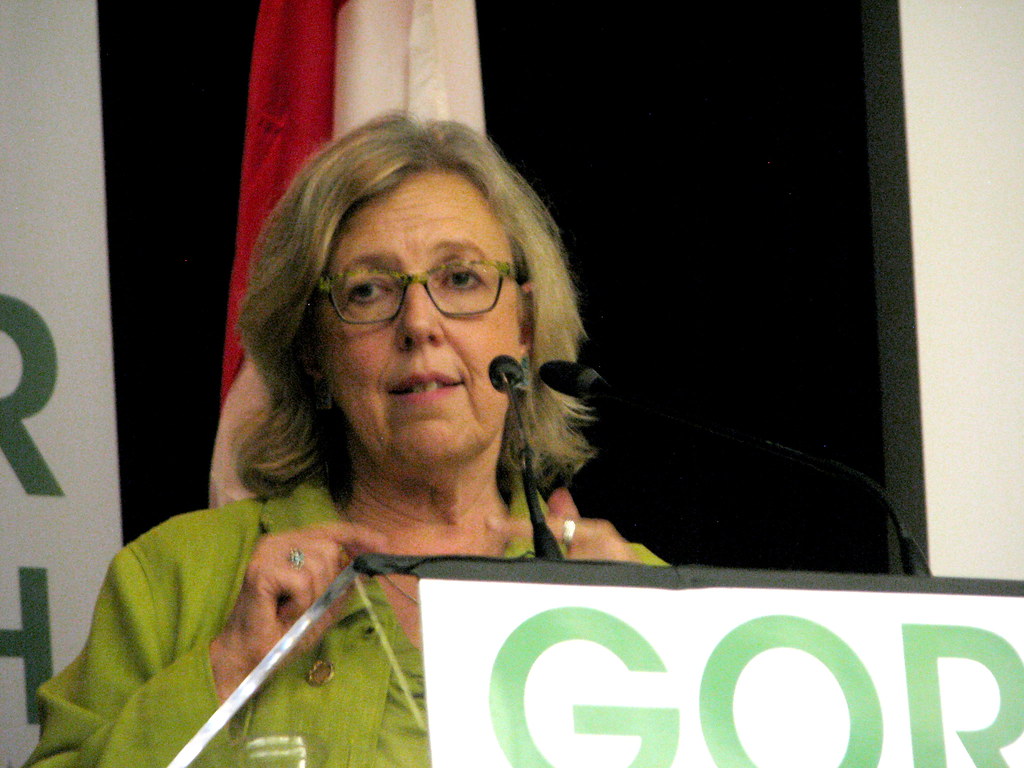
Green Party leader Elizabeth May
'Stampede' voting, not strategic voting, ran them over this election.

Bill Tieleman's 24 Hours Vancouver / The Tyee column 

Tuesday November 3, 2015

By Bill Tieleman
"In riding after riding across Canada, Greens have proven that if you vote (in large numbers) for what you want, you actually get it." 
- Green Party leader Elizabeth May, June 2015 

The Greens didn't get it, in riding after riding -- not votes, not seats.

So the Green party's support withered on the vine in the Oct. 19 federal election, and its hoped for "breakthrough" was actually a breakdown that left it with just one seat.

Green leader Elizabeth May presided again as her party's vote percentage dropped, from 6.8 per cent in 2008 to 3.45 per cent in 2015. 

The Greens won only May's seat in Saanich-Gulf Islands; lost deputy leader Bruce Hyer, a turncoat Ontario New Democrat MP who switched to the Green party last session; saw even its high profile candidates finish in third and fourth place; and managed just one runner up in the whole country.

Quite a depressing turn of events for any analytical Green -- much worse than even the NDP's bad election campaign that squandered its chance of winning government or even staying as official opposition, but still took 44 seats. 

And the now Stephen Harper-less Conservatives with 99 seats are well placed for the next election under a new leader.

May is packing her bags -- not to leave the Green leadership, but to attend the United Nations climate change summit in Paris -- and rationalizing her latest big loss.

"I'm happy with the result... More important than Green seats is that we saw the end of the Harper era," May said, adding that: "The fear factor slaughtered us."

Those grim results shouldn't make any party leader "happy." But on the fear issue, May knew for four years this ballot would be about stopping Harper -- and the Green strategy failed miserably.

Targeting the wrong party

In fact, May didn't follow her own approach outlined earlier in 2015 when the Greens were accused of splitting the vote with the NDP in a way that would let Conservatives win seats. 

Writing in The Tyee, George Ehring asked of May: "Why are she and her party actively pursuing an electoral strategy that is almost certain to elect more Conservatives? 

"In choosing to run candidates in ridings that have the best chance of electing someone other than a Conservative, Elizabeth May is playing right into Stephen Harper's hands," Ehring wrote.

"She is his best electoral ally, because her party will draw votes from New Democrats and Liberals -- the parties with the only chance of defeating Conservatives. This splitting of the opposition votes is just what Stephen Harper needs to form another majority government."

May countered in The Tyee in a long column that gained many readers and Facebook shares.

"Look at these results," May wrote. "Conservative incumbent won last time with 43 per cent of the vote. The Liberal had 39 per cent. And the Green Party had 10 per cent. Ehring would urge, 'Greens should not run here at all!'

"Those are the numbers from 2008 in Saanich-Gulf Islands.

"2011 results in Saanich-Gulf Islands: I won with 46 per cent of the vote, Conservative cabinet minister Gary Lunn 35 per cent, NDP 12 per cent, Liberals six per cent. (Note in 2008, NDP candidate dropped out of the race.)," May concluded.

May also gave the provincial example of Andrew Weaver, the Green party's first BC MLA in Oak Bay-Gordon Head in Victoria, arguing that the Greens had jumped from nine to 40 per cent in that riding in 2013 to displace BC Liberal cabinet minister Ida Chong.

But May misses a critical point: both in Saanich-Gulf Islands federally and in Oak Bay-Gordon Head provincially, Greens defeated right-wing candidates -- not New Democrats. 

Yet in the 2015 federal election, the Greens made environmentally active NDP MP Murray Rankin their number one target riding in Canada -- and failed when ex-CBC host Jo-Ann Roberts lost by 10 per cent. 

They also targeted the NDP in Nanaimo-Ladysmith, recruiting former NDP nomination candidate Paul Manly -- but he came in fourth place.

The hard work of beating Conservatives on Vancouver Island was left to the NDP, with Gord Johns beating cabinet minister John Duncan in Courtenay-Alberni and Rachel Blaney winning North Island-Powell River from the Tories.

Other high-profile Green party candidates like Claire Martin, the former CBC National meteorologist who got environmentalist David Suzuki's endorsement, still went down in single-digit defeat in North Vancouver. 

And in Burnaby-North Seymour, activist anti-pipeline professor Lynne Quarmby finished fourth with just five per cent of the vote.

As it turns out, the Greens didn't actually split the vote in these ridings to let Conservatives win -- perhaps even worse, they made no difference to the results. 

Strategic voting failed

So forget about claiming that "strategic voting" hurt the Greens, or the NDP for that matter, because this was "stampede voting" with the Liberals gaining the herd. Those big Liberal vote totals squashed the Greens like a bug, not strategic voting.

Strategic voting actually means casting a ballot for the incumbent MP -- NDP, Liberal or Green -- in opposition-held ridings and picking the opposition candidate with the best chance to win in Conservative-held seats. 

But that didn't happen, not at all. The NDP's incumbents were wiped out in the Atlantic; in Quebec, the Liberals, Conservatives and Bloc Quebecois defeated the majority of NDP MPs; and Liberals beat New Democrat MPs as well as Conservatives in western Canada. 

That means strategic voting utterly failed.

All of this leaves the Green party back at square one, with one seat of 338 in the new Parliament.

May's "beachhead" riding looks more like Dunkirk than Normandy -- a party in retreat rather than advancing -- and with its hopes dashed rather than invigorated by the results.

The Greens can continue to hold out hope for an electoral change to a proportional representation system that might gain it a handful of seats -- something Justin Trudeau didn't promise, but ironically NDP leader Tom Mulcair did. 

It remains to be seen if Trudeau's plan to somehow change the electoral system -- without allowing Canadians a democratic vote on it -- will help or hurt the Greens, or even take place.

But even in their best-case scenario, would a Green party with 3.45 per cent of Parliament's MPs make a difference?

In many pro-rep systems like those of Germany, Poland and New Zealand, parties with less than five per cent of the popular vote don't earn seats anyway. 

After this election, the Green party looks like a one-trick pony, with one seat and one big challenge: avoid irrelevancy. 

.

Monday, November 02, 2015

Turns Out, the NDP Just Wasn't Ready - How The NDP Campaign Failed

NDP leader Tom Mulcair at rally during election campaign
With a campaign strategy that failed to inspire, it squandered the chance of a generation.

Bill Tieleman's 24 Hours Vancouver / The Tyee column

Tuesday October 27, 2015

By Bill Tieleman 

"I think we emerged from this with a lot of hope for where we can go from here... We have a lot of opportunity going forward." 

- Anne McGrath, NDP 2015 election campaign director

What?! Let me get this straight: the NDP blew its best chance of winning government in history, squandered its lead and dropped by 59 seats -- over half from the 103 it won in 2011 -- and there's "a lot of hope" after the election?

The NDP also lost one million votes from 2011, despite higher turnout, and for the first time in Canadian history saw a third party, Justin Trudeau's Liberals, leap frog over the Official Opposition to win 184 seats -- and there's "a lot of opportunity?"

McGrath's comments are delusional. The NDP's monumental defeat was so devastating that it may take a generation before even a chance to form government happens again.

But McGrath wasn't alone. NDP leader Tom Mulcair's special advisor Brad Lavigne's statements were equally absurd.

"It went so well, for quite some time," Lavigne told Global TV on election night from Mulcair's Montreal campaign headquarters. "Mr. Mulcair ran an incredibly strong campaign and had the support of a good number of Canadians for, I think, 55 of the 78 days, so a lot to be proud of." 

"Are you not stunned by these results? This is not at all what you guys had gamed out," an incredulous Global reporter Mike Le Couteur asked.

"This was certainly going to be an election about change. And Mr. Mulcair was a big part of that. He paved the way with the prosecution of Mr. Harper in the last number of years in the House of Commons and in the first number of weeks in this campaign," Lavigne replied.

"I guess, if there's anything to take away it's that we weren't able to be that agent for change on election day. But so much to be proud of, so many wonderful incumbents returning to Ottawa, so many new folks in our caucus..." Lavigne smilingly concluded.

A lot to be proud of? 

The NDP lost one-third of its support from 2011 and dropped to just 16 seats in what was its 59-seat Quebec power base, while losing all its Atlantic and Toronto MPs.

And it didn't go well enough for high-profile NDP MPs Megan Leslie, Peter Stouffer, Jack Harris, Paul Dewar or Pat Martin, who all lost their seats -- nor for defeated MPs Jinny Sims and Jasbir Sandhu in Surrey, B.C.

Even the late NDP leader Jack Layton's Toronto Danforth seat was lost to the Liberals, while his wife Olivia Chow lost by a two-to-one margin trying to win back a seat in Toronto's Spadina-Fort York.

This kind of denial from the party's senior campaign officials does no good; rather, it tries to deny the need for a critical analysis of what went wrong.
Mulcair has now appointed McGrath to set up a review commission to an election post-mortem.

Let's consider this an open submission.

Battles of the blands

First, the federal NDP's 2015 loss and the failed campaign strategy are hardly unique. Take a look at the depressing BC NDP campaign of 2013, when the BC Liberals snatched away what many assumed was a guaranteed victory for the provincial New Dems.

There was also the disastrous Olivia Chow campaign for mayor of Toronto, where she fell from frontrunner to a "jaw dropping" third.

Then there is the thumping the NDP took in the federal byelection in Chow's former Toronto riding at the hands of Liberal Adam Vaughn, as well as the 2014 Ontario NDP provincial campaign by leader Andrea Horwath that alienated some supporters while ensuring Liberal Premier Kathleen Wynne won a majority government.

Those NDP "battle of the blands" recent campaigns all had several elements in common:

• A mistaken belief that a conservative, play it safe, front-runner, government-in-waiting type strategy would succeed no matter what;

• A focus on risk-averse platforms designed not to rock the boat with centrist voters who might worry what an NDP government would do;

• Running like pale Liberals instead of colourful New Democrats, leaving voters to pick the real thing over the imitation version;

• Weak, mostly content-free advertising focused on the leader only;

• Very few strong social democratic campaign promises that might excite the base; and

• An inability to pivot as circumstances changed during the election.

When the NDP moves to a boring middle road, its Liberal opponents have been able to outflank it on the left -- despite their centre-right governing records -- and offer a more exciting, vibrant brand of government activism than the bureaucratic New Democrats are willing to provide.

In some of these campaigns, senior party officials like McGrath and Lavigne, along with former federal NDP leadership runner-up Brian Topp (now Alberta Premier Rachel Notley's chief of staff), Nathan Rotman, and other NDP veterans played key roles.

For example, Topp ran then BC NDP leader Adrian Dix's 2013 campaign with Lavigne and McGrath assisting, and several senior federal NDP veterans were involved in the Chow mayoralty campaign.

But regardless of the cast, the plot is all too familiar: a campaign that begins with high hopes of victory ends in bitter defeat.

A bad start that got worse

The 2015 campaign that many thought would see Mulcair as Canada's first NDP prime minister started badly and steadily got worse.

At his August campaign launch, Mulcair inexplicably tore a page from Conservative Prime Minister Stephen Harper's "alienate the media" playbook and refused to take questions from reporters.

In just the first hour of his campaign, Mulcair managed to echo the disdainful tone Harper took with the media throughout his tenure -- a bad sign indeed to a national press gallery that expected more from the NDP.

Mulcair also refused to participate in national debates unless the media-despising Harper was present -- that meant ditching the national television broadcasters' consortium English debate. 

With neither the prime minister nor opposition leader willing to take part, what has been the most watched TV debate in the past was cancelled.

Mulcair also bailed out of a debate on women's issues for the same reason.

But those serious missteps weren't fatal, and indeed Mulcair didn't shun the media quite like that again. It was the next one that was.

Balanced budget 'a fatal error'

Astonishingly, on Aug. 25 Mulcair announced that an NDP government would balance the federal budget immediately and thereafter, despite Canada being in a technical recession and despite NDP plans for significant spending on a national child care program and other priorities.

The die was cast. Just two days later, Trudeau reversed his own position that Liberals would balance the budget to boldly state he would run three years of modest deficits of up to $10 billion each before balancing in the fourth year.

It was the clearest differentiation between the two parties fighting to be the change agent, and it put the NDP on the same side of the ledger as Harper's Conservatives.

While the NDP may have believed this was a brilliant stroke, the Liberal campaign team was privately elated at Mulcair's move.

"My biggest concern in the summer time was that they were going to do that before we did," Trudeau's chief of staff Gerald Butts told the Huffington Post in a post-election feature.

The Liberals knew deficit spending would let them be more generous than the NDP in a recession.

"Deficit was the proof point that you were willing to take a risk for the courage of your conviction. We weren't going to tell people that you could have your cake and eat it too. We were being honest," Butts said.

It helped that both the Alberta and Manitoba NDP government were running deficits, undercutting Mulcair's correct but not convincing argument that NDP provincial governments had an admirable financial record for the most part.

It also was of assistance that Ontario's Liberal government was re-elected last year despite big deficits, noted David Herle, Ontario Premier Kathleen Wynne's key strategist and CBC TV commentator.

"To judge from the NDP campaign and the NDP platform, it's like they didn't watch the Ontario election," Herle said.

"The fact that one would run modest deficits in order to invest in the economy right now is not left-wing thinking; it's centrist thinking. That's the platform that Kathleen won on. That's the ballot question she drove against [provincial Conservative leader Tim] Hudak.

"[Ontario NDP leader Andrea] Horwath took herself out of the debate, just as Mulcair took himself out of the economic debate with his platform. And I don't understand how they made that same mistake twice in a row. It was a fatal error," Herle concluded.

Niqab hurt, but wasn't all

Shortly after its no-deficits denouement, the NDP began its long slide from first to third place in the polls.

On Aug. 24, the NDP was at its campaign high point of 37.4 per cent in aggregate polling results compiled by the CBC and analyst Eric Grenier, with the Conservatives at 28 per cent and the Liberals 26 per cent.

By Sept. 18, when the niqab issue was reignited by the Conservative government asking for a stay on a court decision granting Zunera Ishaq the right to wear the Muslim face covering during her Canadian citizenship ceremony, the NDP slide was well underway, with the party below 30 per cent and effectively tied with the Conservatives and Liberals.

While the niqab issue definitely hurt the NDP, with its large Quebec caucus the most affected by anti-niqab sentiments, Trudeau took an equally strong position in favour of a women's right to wear what she wants so long as her identity has been privately confirmed.

Many observers have argued that the niqab was the turning point for the NDP -- when in fact the Liberals with an identical position won 40 Quebec seats last week, the most of any party.

The argument that the NDP's slide in Quebec over the niqab lowered its polling nationally and therefore made voters looking for which party could defeat Harper move to the Liberals is neither convincing nor backed by the polls.

Terrible, not terribly visible ads

The niqab was not the NDP's only problem. Its advertising campaign was terrible -- and not terribly visible.

While the Conservatives targeted Trudeau as "just not ready" and then savaged Mulcair -- and while Trudeau's team took the risky but effective strategy of directly addressing their leader's readiness with a powerful ad showing him telling voters what he's "not ready" for (Conservative failures) -- the NDP was in another world.

Mulcair ads, when seen at all on television, were mostly about his background coming from a large, hard-working family. These are standard and necessary ads to establish who the leader is, but they dominated the NDP airtime and continued far too long at a time when the Liberals were talking about the campaign.

Later ads featuring a smiling Mulcair talked about the need for change, but were light on content and failed to contrast the NDP with its opponents.

Only one truly hard-hitting NDP ad aired, attacking the Conservatives with relish over its ethical lapses -- but it failed to call on voters to elect the NDP to clean up.

And in B.C., at least, it seemed there were far more Liberal and Conservative ads on TV and radio than NDP ads.

Listening to talk and news radio during the campaign was to hear Mulcair denounced three times an hour by Trudeau, who did not hesitate to attack the NDP and say it and the Conservatives would not spend money that was needed for infrastructure and more -- only his Liberals would.

And then, three times an hour on the radio the Conservatives attacked Mulcair as a "career politician" who would ruin the economy -- without any hint of irony that Harper was a career politician who was running Canada in a recession.

Only in the final 10 days of the campaign did NDP radio ads appear to counter the steady stream of negative messages that listeners had heard for months.

Another irony: while the word "workers" seemed to completely disappear from the NDP lexicon, to be replaced exclusively by the vague term "middle class," Harper talked about workers repeatedly in radio ads.

Meanwhile, the NDP put all its advertising stock on a questionable claim that it "only needed" 35 seats to beat the Conservatives, but the Liberals needed 100 -- based on the parties' standing when Parliament was dissolved.

For some voters, the "numerology" approach smacked of arrogance to presume the NDP "owned" those seats and could count them in advance of the election.

Some minor gains

The NDP did have some successes despite the national campaign failure.

In B.C., the party added two net seats and faced down the Green Party on Vancouver Island, winning all but Elizabeth May's Saanich-Gulf Islands seat and vanquishing Conservative cabinet minister John Duncan. The NDP also won three seats in Saskatchewan after being shut out previously.

The new 44-member NDP caucus does indeed have many impressive individuals and it is the second largest sent to Ottawa in the party's history, though in 1988 under leader Ed Broadbent there were 43 MPs in a smaller house, and the party took a slightly larger popular vote.

But the fact that the NDP not only lost an election it could've won, but also lost its Official Opposition status and is now relegated to third place, makes talk of minor gains much too painful.

Those who criticize campaigners should also admit their own failings -- and mine were clear.

The Liberals in B.C. have been mostly dormant for several elections, going into the 2015 campaign with just two MPs and few second-place finishes, but I obviously underestimated the strength of their campaign in Metro Vancouver when I wrote about their chances in early August, while they were still in third place.

With some good candidates, they cleaned up and were able to take the most seats -- 17 -- of any party in B.C., primarily from the Conservatives but two from the NDP.

Nationally, the Liberals ran a brilliant campaign. They took risks with policy shifts that pivoted to take advantage of opponents' mistakes; they created repeatedly memorable images of Trudeau that highlighted his abilities and countered the Conservative attempts to belittle him; their advertising was convincing; and they didn't give up early on when in deep third place.

In the end, this election showed that it was the NDP, not Trudeau, that was just not ready -- not ready to show they could govern Canada by campaigning effectively to win.

.

Stephen Harper - The Man Behind Blue Eyes - Is Gone, Will Our Harsh Divisions Go Too?

The Bad Man Behind Blue Eyes?
The man Behind Blue Eyes polarized Canada like no other leader in decades.

Bill Tieleman's 24 Hours Vancouver / The Tyee column

Tuesday October 20, 2015

By Bill Tieleman 

No one knows what it's like / To be the bad man / To be the sad man / Behind blue eyes. 

- "Behind Blue Eyes," The Who, 1971

Stephen Harper -- the bad man behind blue eyes to some, the only choice for others -- has dominated this election campaign and our country like no other leader in decades.

And now he's gone. Last night's stunning results show just how loathed he was. Voters overwhelmingly turned to his political opposite, Liberal Prime Minister-elect Justin Trudeau, as the best way to end Harper's scary reign.

Despised by not only New Democrats, Liberals and Greens but by many former Progressive Conservative and even some Reform Party supporters, Harper has polarized Canada in a way not seen since prime ministers Brian Mulroney and Pierre Trudeau.

But even that former blustery Conservative and disdainful Liberal respectively didn't engender the same level of loathing that Harper accomplished in just three terms in office.

"No one knows what it's like / To be hated / To be fated / To telling only lies," The Who wrote in a powerful and disturbing song, narrated not by a hero, but a villain.

And to a great number of voters, that's exactly what Harper is -- a bad man.

A country divided

From the implicit racism of fighting the niqab face-covering worn by a handful of Muslim women, to rejecting an inquiry into murdered and missing aboriginal women, Harper has deliberately pushed hot button topics that either infuriate or delight different voters.

Many were appalled by Harper's Senate shenanigans with Mike Duffy and Patrick Brazeau, and by party members convicted of elections violations, such as ex-MP Dean Del Mastro, Harper's own former parliamentary secretary.

Yet there are other voters who see Harper as an economic saviour -- cutting taxes for them and big business, stimulating investments, fighting unions and reducing public services they simply don't want.

That creates extreme views going well beyond the "wedge issues" favoured by politicians to gain an advantage over their opponents.

"There is a segment of Canadian society, about 50 per cent, who absolutely detest Stephen Harper," veteran Canadian pollster Angus Reid told Shaw TV Voice of B.C. host Vaughn Palmer earlier this month.

Indeed, an Ipsos poll confirms that 57 per cent of respondents disapproved of the performance of the Harper Conservative government, but 43 per cent approved of it.

How can Canada be so divided, and hold such contradictory views about one politician? 

And how could Harper say in television ads that: "This election isn't about me, it's about you" with a straight face?

'I have hours, only lonely'

The answer might also be found in The Who's lyrics. "But my dreams / They aren't as empty / As my conscience seems to be," they wrote of their bad man.

Harper and his supporters' conservative dreams of smaller government, fewer public services, lower taxes and less regulation of business are the nightmares of other Canadians.

And the Conservatives' approach to their opponents has never been more fierce and uncompromising.

Even many longtime party supporters I know are personally offended at the total war waged by Harper and his lieutenants on any and all who stand in their way, from judges to journalists.

Why are those Conservatives so angry?

Again, The Who's lyrics haunt when applied to Harper: "I have hours, only lonely / My love is vengeance / That's never free. / No one knows what it's like / To feel these feelings / Like I do / And I blame you / No one bites back as hard / On their anger / None of my pain and woe / Can show through."

The man behind blue eyes often seems to be containing his rage, and biting back on his anger so as not to explode in public.

Two new solitudes

You could almost feel that anger shine through in the last week of the campaign, when Harper joined forces with disgraced former Toronto mayor Rob Ford and his brother, ex-city councillor Doug, at two suburban Ontario rallies.

Many media observers wrongly saw it as indicative of Harper's desperation in his final days to associate with a mayor known internationally for his bad behaviour simply to protect a few votes.

But Harper was allying himself with two other polarizing politicians who deeply understand his situation -- both Fords are also the bad men behind blue eyes, and can empathize with Harper's fate to be hated.

This extended 11-week campaign has shown that Canada has two new solitudes -- no longer between Quebec and English Canada, but an ideological divide perhaps even more disturbing for its lack of tolerance and promotion of discord.

Beyond this election, Canadians will have to find a way to share their dreams more cooperatively in the years ahead.

Otherwise, every new prime minister will soon be the next bad man behind blue eyes.

.