Thursday, October 17, 2013

Why Tom Mulcair Should Toast Provincial NDP Failures to Win in Nova Scotia & British Columbia


The 'paradox of provincial power' means federal NDP MPs' 2015 seats just got a lot safer.  
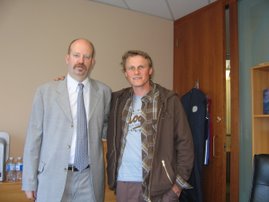
The late Jack Layton and Tom Mulcair, Vancouver, 2007 - Bill Tieleman photo
Bill Tieleman’s 24 Hours Vancouver / The Tyee column

Tuesday October 15, 2013

By Bill Tieleman

"How wonderful that we have met with a paradox. Now we have some hope of making progress."
While New Democrats cry in their beer in Nova Scotia after last week's stunningly disastrous election fall from power to third place, and in British Columbia after blowing a "sure thing" election, federal NDP leader Tom Mulcair might want to drink champagne.
That's because despite the loss of party allies, the NDP nationally almost always suffers in provinces run by NDP governments.
Indeed, the paradox of provincial power means Mulcair's NDP Members of Parliament in B.C. and Nova Scotia just saw their seats get a lot safer in the 2015 federal election.
The evidence? Look back to the watershed 1988 federal election in B.C., fought over the Free Trade Agreement with the United States brought in by Conservative Prime Minister Brian Mulroney.
The NDP in B.C. took 19 of the province's then 32 seats, leaving the Conservatives with 12 and the Liberals just one.
But in 1991, the BC NDP took power provincially under Mike Harcourt and the federal NDP went into a steep decline. The 1993 federal election saw the NDP devastated in B.C., dropping from 19 seats to just two, after two years of the Harcourt administration.
The next federal election in 1997 came with then-NDP premier Glen Clark in power for a year -- with the national party claiming just three seats in B.C.
The 2000 federal vote occurred with unpopular ex-NDP premier Ujjal Dosanjh polling in the low 20 per cent range -- and only two NDP MPs were elected.
But once the BC NDP was demolished provincially in 2001, federal fortunes quickly improved. The federal NDP took five seats in 2004, doubled to 10 in 2006, nine in 2008 and won 12 in the 2011 election.
The same paradoxical pattern plagued the federal NDP when the revered Dave Barrett led the provincial NDP to form B.C.'s first social democratic government in 1972.
The federal NDP went from winning seven of 23 seats in 1968 despite new prime minister Pierre Trudeau's popularity and 11 seats in B.C. in the 1972 national vote to just two seats in 1974.
That fall from grace came as Barrett's government implemented sweeping and at the time often unpopular changes, such as introducing public auto insurance and the Agricultural Land Reserve. They survived but the NDP government didn't.
With Barrett vanquished by Social Credit premier Bill Bennett, the federal NDP bounced back to collect eight seats in the 1979 election.
Dexter's fall
If B.C. is any example, the federal NDP in Nova Scotia would have been similarly disadvantaged by the unpopular provincial government led by NDP premier Darrell Dexter that was trounced Oct. 8, dropping from 31 seats to just seven and into third party status after only one four-year term.
It's also worth looking at the contrast between Dexter and outgoing BC NDP leader Adrian Dix.
Dexter was an affable, TV-friendly leader who seemed destined to win a second term in 2011, riding high in the polls and with a huge $25-billion federal contract to build new warships announced that would bring thousands of jobs to Nova Scotia.
But Dexter broke an NDP promise not to raise taxes, hiking the Harmonized Sales Tax by two per cent in 2010 to Canada's highest rate to deal with an inherited deficit and increasing power rates.
And after it was revealed after the shipyard deal that Nova Scotia was providing Irving Shipbuilding with a $260-million potentially forgivable loan to upgrade its facilities, the good news turned to bad for Dexter.
Add in an MLA expense scandal that began before he took office along with other local issues and presto -- no more NDP government. Embarrassingly, it marked the first time in 130 years that a government was defeated after just one term.
A fickle electorate
While Sun News political commentator Warren Kinsella, a diehard Liberal, makes the outlandish claim that the Nova Scotia election results were Tom Mulcair's fault and "wouldn't have happened if [Jack] Layton was still federal leader," the reality is that the NDP government committed political suicide unaided by the national party.
Veteran pollster Mario Canseco of Insights West also doubts Kinsella's analysis.
"I don't agree with Warren. There's been a tendency from Tories and Grits to deify Layton in an effort to make Mulcair seem weak," he said via email. "I don't think there's much anyone could have done about Dexter."
Kinsella is hardly neutral on Mulcair, calling him variously "a disgrace," "unfit to be prime minister," and "gutless."
"Mulcair can remain a more attractive option without carrying any burden from the provincial defeats," Canseco says. "B.C. shows that the federal party chose wisely by not selecting Brian Topp as leader, and aside from looking at Nova Scotia as a historic failed re-election, I see it more as a sign of a fickle electorate who have sent their government to third place twice in a row-- the Progressive Conservatives in 2009 and now the NDP in 2013."
Too moderate?
Other commentators like Tom Walkom of the Toronto Star more interestingly point to the moderate approach favoured by Dexter and proposed by Dix -- "Change for the better. One practical step at a time" -- to argue that left-wing voters were disillusioned and unenthusiastically stayed home, leading to both NDP defeats.
It's an arguable case, particularly in Nova Scotia after four years of NDP governing, but one which has to be tempered with the reality that Dix, who I supported, pledged from his leadership campaign on to raise corporate taxes, reinstitute a capital tax on financial institutions, oppose the Enbridge Northern Gateway pipeline and address social inequality. None of those positions were ever described as moderate either by the BC Liberals or business.
The Manitoba NDP experience is also telling. The provincial party is enjoying its fourth consecutive term, proving it has the campaign smarts, staying power and governing ability to succeed like the NDP previously in Saskatchewan, whereas B.C., Ontario and Nova Scotia have mostly failed.
But the federal NDP's fortunes during those four terms in Manitoba have been less than stellar, though not as roller coaster as B.C.'s. Manitoba has elected between one and four NDP MPs of its current 14 seats during the provincial party's tenure, first under Gary Doer starting in 1999 and then Greg Selinger in 2009, both regarded as moderates.
Regardless of the moderation debate -- and it's a critical one for the NDP -- what is unequivocal is that the federal NDP may have dodged two bullets in 2015's election by seeing its provincial wings in B.C. and Nova Scotia relegated to opposition, not government.

.

Thursday, October 10, 2013

BC Politics and Economy: Why Can't We Be Friends? SFU Public Square brings together the solitudes


SFU forum on BC economy shows political nemeses can set aside acrimony for harmony and tackle issues together.  
Bill Tieleman‘s 24 Hours Vancouver / The Tyee column

Tuesday October 8, 2013

By Bill TIeleman

"So where are the strong / And who are the trusted? / And where is the harmony? / Sweet harmony."
- Nick Lowe, "(What's So Funny 'Bout) Peace, Love and Understanding?"
If there's just one thing everyone in British Columbia politics could agree on, it's that we can't be friends.
From business and labour, to environmentalists and natural resource companies, to First Nations, anti-poverty and other groups, it's clear B.C. is definitely not home to sweet harmony.
Confrontation always seems to beat cooperation.
That's why it's so astonishing when something harmonious happens here, and I was fortunate enough to witness it.
On Friday, strong and trusted representatives of all these sectors sat down in the same room to discuss how to improve B.C.'s economy -- to create wealth but also address social equity issues and environmental protection.
Now that's radical! And you know what else is?
Hearing B.C. Business Council CEO Greg D'Avignon state that increasing support for early childhood education is "vital" to the province's success.
Or Vancity Credit Union CEO Tamara Vrooman, a former B.C. deputy minister of finance, telling participants that a business "can have progressive values and prosper" as well.
Or BC Liberal Finance Minister Mike de Jong acknowledging in his opening speech the presence of NDP leader Adrian Dix and NDP MLAs Carole James and Bruce Ralston.

It all happened thanks to Simon Fraser University's Public Square forum, an effort "for enlightenment and dialogue on key public issues."
Busting out of the silos
SFU president Andrew Petter, himself an ex-NDP finance minister, said in an interview after the forum that British Columbians need to "take more responsibility as citizens to resolve issues and not just leave it to the politicians."
"There needs to be more space in this province that's 'neutral ground' not governed by partisan politics," Petter explained. "At a high level, there's consensus."
Petter believes business understands economic growth must accompany improved equality and include environmental sustainability, but that requires dialogue.
"So often in this province we gather in groups of like-minded people in our own silos," Petter said. "We need to create a more collaborative environment, to encourage politicians to be more collaborative."
Was there disagreement in the forum as well as cooperation? You bet!
The rules of participation required that I not quote individuals in order to encourage open discussion, but I can say that there was spirited debate.
And pointed commentary, like when Chief Sophie Pierre, head of the B.C. Treaty Commission, remarked in an open-to-media session that "when a First Nation benefits, the whole region benefits -- but it's not necessarily true the other way."
Or when Yuen Pau Woo, CEO of the Asia Pacific Foundation, said that Vancouver is the "most Asian city outside of Asia" but then added: "There's not that many Asians in this room, by the way."
Sweet, uncertain harmony
But what was most striking is that it wasn't the strident, confrontational or close-minded bluster that often passes for debate in B.C.
Despite being known as a fiercely partisan left and labour supporter, I value good friendships with people from the right and in business -- because we often agree on many things while adamantly but politely disagreeing on others.
I've worked with previous adversaries like ex-premier Bill Vander Zalm on the same side of issues, such as eliminating the Harmonized Sales Tax, building new ferries in B.C. rather than Germany, and not privatizing BC Rail.
The point isn't the issues themselves or that others hold equally strong opposing views; it's that British Columbians with different perspectives can and do come together in common cause, despite the perception that this is a province of many solitudes.
The challenge is to find more issues where we can agree and make concrete progress, such as the need to improve skills training and provide more work for British Columbians -- and not poison the well over points where we can't reach consensus.
Some of the background discussion material produced by SFU show how important that is, from B.C. having the worst child poverty rate in Canada -- tied with Manitoba at 11.3 per cent -- to having the second highest gap between low and high income earners, to having aggregate labour productivity at 10 per cent below the national average, and much more.
The forum demonstrated that people with dramatically divergent views can talk productively about these issues, if only for a day to start. But will anything come of the temporary, uncertain harmony in the room?
That depends. There was consensus that SFU's public square -- or some other body, dare one suggest the province -- needs to do this again soon.
That's a tall order anytime, and especially after a rancorous election campaign, but the startling fact that so many different leaders who never talk could spend a day together in relative harmony -- and want to do it more -- is a promising sign.

.

Tuesday, October 01, 2013

BC Liberal MLA John Yap Must Go As Parliamentary Secretary to Attorney General Because Of Investigation Into Ethnic Outreach Scandal When Yap Was Minister


Why is former minister John Yap - mired in BC Liberal outreach scandal - still working for BC Attorney General and Justice Minister Suzanne Anton?

BC Liberal MLA John Yap
"An apparent conflict of interest exists when there is a reasonable apprehension, which reasonably well-informed persons could properly have, that a conflict of interest exists."

Why is BC Liberal MLA John Yap still serving as parliamentary secretary to the attorney general and justice minister while RCMP and a special prosecutor investigate the ethnic outreach scandal?
Yap resigned from cabinet as B.C.'s minister responsible for multiculturalism after it was revealed that activities in his ministry crossed the line from government work to partisan politics at taxpayer expense.
A report by Premier Christy Clark's deputy minister John Dyble concluded "lines between party work and government are clearly crossed" in a meeting Yap attended with ethnic outreach staff.
The staff involved, Dyble wrote, "breached the Standards of Conduct in the blending of coordination of ministry and partisan events."
Yap also admitted his ex-staffers Brian Bonney and Mike Lee used private emails to avoid Freedom of Information requests, violating government legislation.
And for good reason.
An email Yap received from Lee's personal account told him: "It is absolutely critical that we do not leave any evidence" about assistance hiring three ethnic outreach community liaisons that Yap knew, the Dyble report says.
"I made a mistake here, and I'm owning up to it. I've learned the hard way that was not appropriate," Yap said in March.
So why is Yap still in a key position as assistant to Attorney General Suzanne Anton, while the RCMP and special prosecutor David Butcher probe possible Elections Act violations and potentially lay charges?
It's simple: Yap must go
It's called apparent conflict of interest -- and it's obvious that Yap shouldn't hold his position while the investigation takes place.
Indeed a Sept. 26 BC Criminal Justice Branch statement said the appointment of a special prosecutor was made: "as the investigation could include members of government and/or government employees."
Yap may be completely innocent of any wrongdoing, but that's not the point.
What's important is that Yap, someone likely to be questioned about ethnic outreach issues, not be at the same time in a prominent position in the ministry responsible for supervising police and justice.
It's really not complicated. Yap simply has to go.
After all, look at what happened in March 2013:
Yap was out as minister responsible; Premier Christy Clark's deputy chief of staff Kim Haakstad and Yap's executive assistant Mike Lee resigned for their roles in those so-called "quick win" activities; and the BC Liberal Party paid the province $70,000 to compensate for the inappropriate partisan work done by government staff.
Later the NDP made allegations that Bonney, as communications director for the multiculturalism ministry, offered a job to a disgruntled staff person involved who had information that "would damage the Premier and the (Liberal) party" -- according to an email sent by Bonney.
B.C. New Democratic Party leader Adrian Dix triggered the current investigation by sending a private letter containing new information about the scandal to the RCMP.
That information has not been made public, but it obviously was sufficiently important to warrant the appointment of a special prosecutor.
The BC Criminal Justice Branch statement said that no word about the appointment had been released until then "at the specific request of the RCMP to safeguard the integrity of the investigation in its early stages."
Clark survived the ethnic outreach scandal to win the May election, but she should not put political loyalty to Yap ahead of the integrity of the investigation. Yap must go until it concludes.

.