Tuesday, January 15, 2013

EXCLUSIVE: Right-wing Group Plans $1 million 'Blanket Coverage' Ad Blitz Against BC NDP


Million dollar campaign supporting BC Liberals helped by federal Liberal lobbyists. 
Jim Shepard of Concerned Citizens for BC
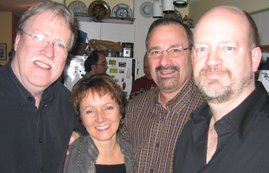
Wazuku Advisory Group's Michael Watson, Brad Zubyk & Steve Kukucha - website photo
Bill Tieleman’s 24 hours/The Tyee column

Tuesday January 15, 2013

By Bill Tieleman

"Christy has not been given a fair shake. She has not been identified as a competent premier." 

-Jim Shepard, Concerned Citizens for B.C.

A political action group formed by a retired corporate leader will soon launch a $1 million "blanket coverage... full multi-media campaign" to attack the BC New Democrats and help re-elect Premier Christy Clark's BC Liberals, according to leaked documents obtained by 24 hours Vancouver and The Tyee.

And Concerned Citizens for B.C. -- created by Jim Shepard, the right-wing former Clark economic advisor and ex-Canfor and Finning International CEO -- is running the campaign with the help of prominent lobbyists with strong ties to the federal and BC Liberal parties.

CC4BC, as it refers to itself, told supporters in a Nov. 30, 2012 email obtained by 24 hours about advertising plans that "the cost of such a bold undertaking is $1 million" and that it is "already to $520,000."
"The positive feedback we get from all quarters indicates we will reach our goal well before year end. That will enable us to come out with a full multi-media campaign early in the New Year," the email sent by Shepard states.
No spending limits or disclosure
Shepard has been a vociferous critic of the NDP, claiming that it introduced "socialism" when in power in the 1990s.
"You know, we lived through socialism in B.C. for 10 years. I know what it looks like and it is not pretty," Shepard said in 2010, adding that he was similarly worried about U.S. President Barack Obama political proclivities.
Shepard's $1 million advertising campaign -- or any other -- isn't subject to any spending limits or financial disclosure so long as it concludes before the provincial election officially begins with the writ being dropped 28 days before the May 14 vote, Elections BC confirmed Friday.
That's because a court decision striking down BC Liberal legislation that attempted to ban pre-election advertising.
Ties to Grits
Wazuku Advisory Groups' Kirsten Avison confirmed in a telephone interview Friday that the firm is doing paid work for CC4BC but had no details on its ad plans and did not call back with additional information as requested or respond to email.
Wazuku's three principals are Mike Watson, Brad Zubyk and Steve Kukucha. Kukucha did not return telephone and email interview requests.
Both Kukucha and Zubyk have strong ties to the federal Liberal Party as well as the B.C. Liberal Party and Clark.
Zubyk was communications director for the federal Liberals in B.C. in the 2008 and 2011 campaigns and Kukucha was senior advisor to former Liberal Environment Minister David Anderson.
Wazuku, Kukucha and Watson are BC Liberal Party donors.
Zubyk was also active in Clark's BC Liberal leadership campaign and has worked for the Independent Contractors and Businesses Association in an expensive anti-NDP campaign before the 2009 election. The ICBA's Philip Hochstein is a vociferous opponent of the NDP and unions in B.C.
Zubyk also testified for the B.C. government in court in support of its earlier legislation restricting election advertising.
Ironically, Zubyk's political career in B.C. started when he was communications coordinator for the NDP caucus under then-Premier Mike Harcourt and he later ran two unsuccessful BC NDP leadership campaigns for ex-MLA Corky Evans.
Zubyk's current lobbying clients include General Electric Canada and the B.C. Maritime Employers Association.
Kukucha, who has previously been active in independent power production, has lobbyist clients that include Ballard Power Systems and Blu Earth Renewables Kukucha has also been a federal lobbyist but currently has no active clients.
Watson is a BC Liberal government appointee on the Pacific Carbon Trust and a national director of the Canadian Chamber of Commerce.
'Oh really?'
But despite the colourful background of CC4BC's top advisors, its biggest problem may actually be founder Shepard. The ex-CEO is an evangelical supporter of Clark and the "free enterprise" cause but he is often short on facts.
In an interview with CKNW radio host Bill Good on Jan. 8, Shepard was definitive on the NDP record -- but wrong.
Good: Fiscal management does not seem to be a high point of this government today... It's not been balancing its budget.
Shepard: They have not done as well as they should have. They only balanced their budget four times out of the last nine attempts.
But if you look at the previous nine years with the NDP, they never had one single balanced budget.
Good: They had two.
Shepard: Oh really? Which ones?
In fact, the NDP left office in 2001 after two balanced budgets.
But despite Shepard's shaky grasp on political and financial reality, he has a $1 million ad campaign ready to launch -- why let any facts get in the way?

UPDATE:  In an ironic twist that must have Shepard and his supporters apoplectic, BC NDP leader Adrian Dix helped open the Toronto Stock Exchange today with Catalyst Paper!  

Apparently NDP "socialism" isn't what it used to be.

See also related story by 24 hours Richard Sussman:  


Negative publicity nothing new to NDP’s Dix


.

Tuesday, January 08, 2013

Ice Ice Baby, Whose Fault Is Port Mann Bridge and Black Ice Caused Crashes? Don't Ask Transportation Minister Mary Polak!


If ice is a problem, yo, you can solve it - on Port Mann Bridge - not blame drivers for black ice crashes
New Port Mann Bridge in the fog - like the Minister? - Carmine Marinelli Photo for 24 hours Vancouver
Experts raise questions about gov't decision to blame drivers, chill out on builders

Bill Tieleman’s 24 hours/The Tyee column

Tuesday, January 8, 2013

By Bill Tieleman

"@Surrey Police: #IceIceSurrey If ice is a problem, yo, you can solve it, check out this link while my DJ revolves it."

- Surrey, England police warning on Twitter. 

Who knew that the $3.3 billion Port Mann Bridge was designed by slippery '90s rapper Vanilla Ice?
Not B.C. Transportation Minister Mary Polak, who will probably never listen to "Ice Ice Baby" again.
More importantly, why was Polak blaming the 40 unlucky drivers involved in ice-caused crashes on the bridge Thursday?
Why was she also blaming the totally predictable freezing wet, foggy weather --everything but the actual contractor responsible for making sure there's no ice on the bridge?
"There's nothing they've done that they were negligent in," Polak said of Mainroad Contracting. "There's nothing with respect to what they did that they could have predicted what did happen with any certainty."


Polak went on to put the blame on drivers. 
"People are able to reach speeds on the bridge at rush hour they never were before. As with any type of crash, there's a number of different causes and issues at play. This is unfortunately just the kind of circumstance people encounter on the road... chain reactions result in large numbers of claims," Polak continued.
There's only one problem with that last statement. The minister doesn't know her ice from her elbow.
'You can lose control on black ice at 10 mph'
The website Icy Road Safety explains all that Polak needs to understand about this winter hazard.
"Attributing the root cause of road ice crashes to people driving too fast is similar to saying that plane crashes are caused by pilots failing to keep their aircraft in the air," the website explains. "For black ice, no speeds are safe. You can lose control on black ice at 10 m.p.h., particularly if there is any banking or slope to the roadway."
And guess what? The new sloping Port Mann Bridge was covered in black ice, despite the contractor claiming they patrolled it just an hour before and found no problems.
But when you apply a salt brine solution 25 hours in advance and hope everything will stay safe, you're on thin ice.
As police reported, there was no visible salt or gravel and more ice than the Vancouver Canucks have seen this season.
Despite that, Polak argues neither the contractor nor the province is responsible for the crashes and not only will drivers' tolls not be refunded, they'll be responsible for ICBC insurance deductibles too.
Cold, hard reality check
If your car was damaged Thursday, you might think about calling a lawyer and then asking the experts from Icy Road Safety to testify, because here's what they say:
"An icy bridge's most dangerous threat is their element of surprise -- they catch drivers off guard, who are traveling at full speed because the rest of the roads are either clear or just a little wet," the website notes, adding that bridges freeze first because they are exposed top, bottom and sides by icy air compared to just the surface on a road.
And unlike B.C.'s transportation minister, the website, supported by several American state transportation agencies, cities, weather services and others, doesn't blame drivers.
"The result of a vehicle encountering black ice is no different than if it had been blown off the road by a tornado, in that both are 100 percent a result of external weather-related forces that are of no fault of the driver," it states.
Polak should do the right thing -- demand the contractor pay for damage done to cars last week and make them responsible for any similar black ice bang ups.

.

Monday, December 31, 2012

Jesus would be mad at charity requests - because society should help those in need, not individuals


Why Jesus Would Be Angry This Christmas

Andrew Pudas - Ceramic artist - "Angry Jesus"

He'd be mad about all those charity requests as wealth inequality grows.

Bill Tieleman’s 24 hours/The Tyee column
Tuesday December 18, 2012
"Speak up and judge fairly; defend the rights of the poor and needy."
- Proverbs 31:9, the Bible 

Jesus would be angry this Christmas, furious to see charities feeding the hungry, helping the homeless, comforting those with disabilities and supporting the poor, all asking for donations.

But Christ wouldn't be mad at those worthy groups doing good works. He would be disgusted our society refuses to properly care for those in need, making them depend on the whims of individual generosity.
 

From groups running food banks to providing shelter to the homeless to assisting people with disabilities from losing their already pathetically low income to those advocating against poverty, all are desperately and perpetually short of operating funds.
 

And without our financial help, real people suffer.
 

Jesus would simply ask: why?
 

Why in a society as developed as Canada's, in a province as full of natural resources as British Columbia, in a city as conspicuously wealthy as Vancouver, do so many live below the poverty line?
 

The answer doesn't need to come from Jesus, or Buddha or Muhammad or Guru Nanak. It can easily come from us.
 

The poor, the sick, and the disadvantaged suffer because we like it that way.
 

No, not because we are all hard hearted sociopaths who couldn't care less about others.
 

The reason is because we'd rather not pay higher taxes to redistribute wealth more equitably.
Another Christmas, wider disparities
Both the federal Conservative and B.C. Liberal governments explicitly ran campaigns promising and delivering tax "relief" to voters -- but mostly to those who are already extremely well-off.
 

As a result, both Canada's and B.C.'s income inequality has grown dramatically for years.  
These governments have intentionally made it more difficult to collect employment insurance, disability benefits and social assistance.
 

The effects are very clear.
 

B.C. has the second worst child poverty rate in Canada after boasting the absolute worst for the previous eight years.  
Canada's 4,500 food banks have experienced the kind of phenomenal growth in "customers" that any actual private bank would celebrate wildly.
 

More than 882,000 Canadians depend on food banks, an increase of 31 per cent since 2008. In B.C. over 96,000 people use food banks, a 23 per cent jump since 2008.
 

But the only "reward" for food banks -- originally established as a temporary measure -- is increased dependency and lack of sufficient supplies for those they serve.
 
People with disabilities in B.C. have to survive on as little as $906 a month for a single adult -- $10,877 when the Low Income Cut Off indicator for poverty is $23,637.
The gift of social progress
 
No, if Jesus came back to visit us this Christmas he would be righteously angry -- and organizing for social change.
 

So as you celebrate the season, please give money to causes that urgently ask for your help.
 

But also demand that all governments do more to share the wealth our rich society creates.  
 

That would be a truly meaningful Christmas gift to those who need it most.

.

Why doesn't Canada have a state-owned energy company when China and most of world do? Answer: Conservative ideology over common sense

If China Can Have State-Owned Energy Firms, Why Can't We? 
Once upon a time PetroCanada belonged to all Canadians as a state-owned energy firm
Question looms after Harper's sell-out of Canadian interests with CNOOC, Petronas takeovers.

Bill Tieleman’s 24 hours/The Tyee column

Tuesday December 11, 2012

"To be blunt, Canadians have not spent years reducing the ownership of sectors of the economy by our own governments, only to see them bought and controlled by foreign governments instead."
There are many good reasons that the Conservative government should have rejected the $15 billion takeover of Canada's Nexen oil and gas giant by the China National Offshore Oil Corporation instead of accepting it last Friday.
Refusing to sell out ownership of our natural resources to a foreign company, for example, or rejecting China's appalling human rights record and undemocratic rule by dictatorship or just because the benefits to Canada are not sufficient.
But for Harper to allow the deal to go ahead while bitterly complaining that it won't happen again because CNOOC is "state-owned" is not a good reason -- it is an indication of his libertarian free-market at all costs ideology.
And not surprisingly, it's a dogmatic view Harper shares with the right-wing Fraser Institute, which argues that private ownership is "more productive" than public ownership despite evidence to the contrary.
Harper's words also applied to a second deal his government allowed, the $6 billion takeover of Calgary-based natural gas company Progress Energy by Malaysia's state-owned Petronas.
And the prime minister's objections aren't based on the fact that CNOOC is controlled by a Communist -- in name only -- regime. No, just that it is owned by a government instead of shareholders.
"The government's concern and discomfort for some time has been that very quickly, a series of large-scale controlling transactions by foreign state-owned companies could rapidly transform this (oil sands) industry from one that is essentially a free market to one that is effectively under control of a foreign government," Harper said.
Once upon a time Canada also had a state-owned energy company -- PetroCanada -- that allowed the country to have a significant window on the oil and gas industry from top to bottom, from oil exploration to gas stations.
What's more, five of the top 10 most profitable companies in the world are big oil and gas firms.
So what's wrong with taxpayers having a little skin in that game and some profits to reduce taxation levels?
Perfectly normal
For any nation to have a state-owned energy firm isn't strange or restricted to unelected regimes. Norway,Venezuela, Mexico and Brazil are among dozens of nations with publicly-owned oil businesses, which collectively control more than 75 per cent of world crude oil production.
In fact, Canada and the United States are the only major oil-producing countries without publicly-owned energy firms.
And strong arguments can be made in favour of national oil companies. A recent article in Forbes business magazine -- hardly a socialist hotbed -- says there are many reasons why NOCs can be beneficial.
"Leading NOCs not only channel capital, technological and operational know-how into the country, they also serve as custodians of their nation's wealth," writes José de Sá of Bain & Company.
"Ideally, they help insulate the socioeconomic development strategy from pulls and pressures, and they guard its integrity as the country moves through economic cycles. Most important, they maintain a steady course in the quest for global competitiveness," he wrote this year.
Ideological blinders
But what is strange is that PetroCanada began to be privatized by a Conservative government and the Liberal government that followed finished it off.
Apparently there's a lot wrong with public ownership of natural resources -- if you are ideologically motivated to oppose it.
That may explain why the two parties that have alternated in governing Canada for more than the past century both wanted to get rid of PetroCanada.
And their lack of commitment to Canadian ownership of our own natural resources is why both Harper and the Liberal Party's heir-apparent leader Justin Trudeau both approved of the CNOOC and takeover.
So while the rest of the world reaps the rewards of public ownership of natural resources, Canada has not only gone in the opposite direction, it's also allowing foreign companies to take over what is rightfully ours. Brilliant.

.

Tuesday, December 25, 2012

Merry Christmas to all!

Merry Christmas to all my readers - may it be happy, healthy and peaceful!

Van Dusen Gardens - Festival of Lights - Bill Tieleman photo