Debate started Tuesday October 16 in the BC Legislature on the Tsawwassen First Nation Final Agreement Act.
The following are Hansard Draft excerpts from New Democratic Party MLAs, including Leader Carole James, on the Treaty and in particular on its exclusion of farmland from the Agricultural Land Reserve for Deltaport expansion.
Tuesday October 16, 2007
[DRAFT TRANSCRIPT ONLY]
Carole James - NDP leader & MLA - Victoria-Beacon Hill
C. James: I rise with pride today to speak to the Tsawwassen treaty. I rise with feelings of pride and optimism for the future of Tsawwassen people, but I also have feelings of great concern about this government's approach to treaty-making — past, present and future. And I'm going to take some time this afternoon, as I go through my remarks, to talk about that and to talk about some ideas of how to improve that process.
But I want to start by saying how proud I am to stand with my caucus to support the Tsawwassen treaty. It will be a momentous day for the Tsawwassen people when this treaty is finally ratified by all parties and comes into effect. It will be a genuine cause for celebration.
.....In the 1990s the Leader of the Opposition, now the Premier, opposed race-based aboriginal government. The Nisga'a treaty was unconstitutional, he said. Non-Nisga'a citizens would be subject to Nisga'a laws, he said. Non-Nisga'a citizens would be burdened by taxation without representation.
Even when the courts told the Premier that he was wrong, he fought back with a terribly divisive and racist provincial referendum that did nothing except create more divide — after a history of divide in our province — and delayed treaty talks.
Then we all know that suddenly, in 2005, the Premier began promoting a new relationship. Given the Premier's history, first nations and the general public both have good reason to wonder whether they're dealing with a far-sighted statesman or a partisan tactician. [DRAFT TRANSCRIPT ONLY]
I have to say that I believe a statesman would have found an honourable way to treat the Tsawwassen First Nation and protect the agricultural land reserve. A partisan would have played one off against another. A far-sighted strategist would have worked hard to resolve this critical land use dispute. A mere tactician would have gone for short-term political gain. [DRAFT TRANSCRIPT ONLY] We all know what happened in this case. As a result, neither first nations nor the general public really knows where this government and this Premier stand on the toughest of historical treaty issues. [DRAFT TRANSCRIPT ONLY]
Guy Gentner NDP MLA - Delta North
This treaty, in addressing old wrongs, is writing into history, I believe, a new wrong. The new wrong is the dismantling of the agricultural land reserve, and it will be the death of the ALR.
If we approve the removal of the province's most valued agricultural land for treaty settlement, then all agricultural land is on the table, Crown or otherwise.
The precedent will be set. The province's willingness to barter away farmland is the death knell for more to be lost.
Further, by losing that land for the express interest of global profits, from which you and I really won't benefit, we are also sounding the death knell for our future food resources, our future health and welfare, our future environment and, indeed, our very future.
I asked at the beginning: what price do we put on what is going to be lost? It seems to me that what we have here, written in such fine detail in the VPA agreement, is that the costs of repairing the past is the future of farmland. Is this what we want?
What was done in the past and the long-lasting impacts on indigenous people was, to our modern and hopefully more enlightened minds, morally reprehensible. There should have been amends long ago, and it is long past time to sign treaties and enable first nations to move toward their own future.
But what future will that be if we do not protect the very land that feeds us all, if we do not protect the environment that is our collective responsibility?
We are in the process of legislating the end of the agricultural land reserve and gaining a parking lot of containers. Fields of containers is what our future will be with this legislation — the legacy of this government.
We are going to fix a horrendous wrong with containers. Is this truly what we want?
. . . . Someone is going to make a lot of money from this, a heck of a lot of money. Only a very few people will benefit, and it won't be all the TFN members. A special few will benefit, most of whom live outside the province.
The rest of us will pay. We'll pay with our taxes, pay with our health and pay with our future. The Premier is finding that it isn't really easy being green.
Scott Fraser - NDP MLA Alberni-Qualicum
As has been mentioned, the Tsawwassen treaty has not been without debate. New Democrats have strong and passionate beliefs. Two of those issues that we feel most strongly about are settling first nations treaties — it's a human rights issue — and preserving B.C.'s food-producing lands.
It was also the NDP that created both the ALR — the agricultural land reserve — and the treaty process. So as a party and as a caucus, we have the obligation to carefully consider the implications of the Tsawwassen treaty for farmland. This debate is intelligent, it's healthy, and we should all be proud of it.
The New Democrat caucus has had in-depth discussions about these issues, and we've come to a decision to support the treaty. However, as the official opposition, it is our right and our role to raise important questions. So we will stand in the Legislature and give voice to your concerns, which we all have in British Columbia, about the loss of agricultural land, which produces food for communities in the region and beyond.
The ALR is one of B.C.'s greatest legacies, and we will not lose sight of that — of the crucial importance of the legacy of the ALR for the people of British Columbia, particularly in the times of climate change.
We will also raise important concerns about this government's plans for expansion of Deltaport and how these plans impact the fertile and irreplaceable agricultural lands in the area, especially when alternatives are available — ports, facilities such as in Prince Rupert.
. . . . As New Democrats, we will build on the momentum that the Tsawwassen treaty offers, momentum towards reconciliation — more than just the word — and towards protecting farmland, which is our future food security.
As we continue the journey towards reconciliation, the NDP will stand by our commitment for the preservation of farmland — not just today, not just for today's generation, but for future generations. This must also be a key part of the treaty process.
Leonard Krog - NDP MLA Nanaimo
I'm going to accept that the government members have changed their minds, many of them. I'm going to accept that they are now sincere in their support for first nations people across this province.
I'm going to accept that they want to build a just society, a society where social and economic justice are the hallmarks, not just for those of the dominant culture but for those who are of first nations ancestry — those who occupied the land from time immemorial, long before the Spanish came or the Russians or the English or the French.
I'm going to believe that they're sincere in that. I'm going to believe that they want to do the right thing. But the way the agricultural land, which is of such great importance to British Columbians, was included in this treaty gives the opposition some reason for concern.
The commitment to preserving agricultural land is one that is strongly felt by British Columbians. It is indeed the one thing, apart from some awful tinkering, that successive governments, since its introduction by Dave Barrett and Dave Stupich, have not really tried to trifle with.
There have been some changes under this government that are quite unpalatable and that any responsible government elected to succeed them will change, but the fact is they haven't played with it. They understood its importance and its significance to British Columbians, just as the preservation of land, and the land, is so important to first nations people in this province, understanding that intense relationship that exists between first nations people and the land.
One could say that if the NDP had negotiated this treaty, maybe we would have and could have done it differently. But as I have said to some of my constituents who question the treaty, this is like an election. This is exactly like an election. You never get to pick the perfect choice. We have a treaty that we can support or we can oppose. We don't get the treaty that each and every one of us might exactly support.
. . . . The opposition will support this treaty. The opposition will continue to have its concerns about the agricultural land. But when you weigh the issue of the ALR and agricultural lands against the profound importance of the treaty process succeeding, I would suggest to those who have those concerns that the success of the process far outweighs the issue of the agricultural lands.
I say that as someone who is profoundly proud of the agricultural land reserve, as someone who is absolutely astonished that this government, in a time when we're all talking about hundred-mile diets and the importance of being self-sufficient in food and about food security, would throw this in as part of the treaty — to use it as some political football, arguably.
But you know something? I trust the Tsawwassen people. They have much for a future to look forward to.
Wednesday October 17, 2007
David Chudnovsky - NDP MLA Vancouver-Kensington
It's a good day for the Tsawwassen people, and it's a good day for British Columbia, and it's a good day for Canada, because this treaty speaks to the hopes and the desires and the dreams of a first nation and of a province and of a country.
That's not to say that I don't have concerns, serious concerns, about this treaty and about this legislation, and I want to talk about those concerns in some detail in a few minutes.
. . . . Once he formed government, this Premier insisted on holding an expensive and ultimately meaningless referendum on treaties in 2002. First nations condemned him. Polling professionals ridiculed the questions and the methodology and the process.
Everyone who understood the reality of the history of aboriginal people in British Columbia was appalled.
Now, finally and happily, the Premier and his government have changed their tune, but the political opportunism remains.
How else can one describe the government's decision to use public funds to take Tsawwassen people to Nisga'a territory to observe the results of a treaty that this Premier and this government opposed so enthusiastically?
. . . . I said earlier that even though I'm proud to support the treaty and the legislation, I have real concerns about some of its elements. Many people are concerned about the treaty, and many are even critical of it. That shouldn't surprise us. Together with the debate around this treaty, some of our most cherished principles are put into stark relief. There are tensions and conflicts between and among them.
The treaty process, the ALR, self-government and self-determination, local and municipal governance, protection of the environment, redress and reconciliation, food security, social justice. Each of these is for me a touchstone, a measuring stick, a way to figure out where I stand and how I should behave. So, like others, when those principles don't all line up in one direction, I have to struggle to find a way forward.
. . . . There are some who say that the Tsawwassen treaty is an attempt by this government to make an end run around the ALR. I think they're right.
Many say that the treaty is a way the government hopes to get around municipal concerns regarding control over development in Delta.
Critics assert that the treaty is being used by the Liberals to avoid their responsibilities to sustainability and the environment, to protect, for instance, the Fraser estuary and the Georgia Strait. They argue that the treaty is all about massive expansion of Deltaport.
My view is that we should take every one of those criticisms seriously. I think there is merit in each of them. There's no doubt the Tsawwassen peoples' legitimate interest in self-determination and in economic development is being used by a cynical government to push a project that is far more important to them — the government — than the Tsawwassen people or any other first nation in B.C. — namely, massive expansion of Deltaport and a socially and environmentally irresponsible version of economic development.
. . . . The Tsawwassen people had no control over the creation of the ALR or its relationship to their traditional territory. So, despite the legitimate criticisms, I cannot reject the treaty on these grounds precisely because it is the treaty which will provide the Tsawwassen First Nation the possibility, finally, to participate in determining their own future.
We, who have done such a poor job in ensuring social justice and environmental sustainability, have a lot of nerve denying them the right to try to do better than we here — even on their land, and even if they make some mistakes.
Chuck Puchmayr - NDP MLA New Westminster
Last year New Westminster hosted the Pulling Together. I was able to make a presentation at the Tsawwassen longhouse. I left a message for Chief Baird from my leader, the official opposition. The message was that we understood what they were facing, and we could understand that there was some anxiety with the people on the Tsawwassen First Nations land with respect to the upcoming vote. The message from my leader was that we support any direction that they take.
. . . . Back to Tsawwassen, there's certainly some concern about the farmland. We're not going to not talk about the issue of farmland. Farmland is very crucial to the survival of this planet. It's very crucial to have farmland so that you can develop your own food for your own people.
Just as the first nations do, we need food as well. We cannot start to depend on foreign countries to provide us with food. It may look advantageous today, but it could be a disaster for us in the future.
There's no doubt that there are some concerns, and I'm sure the concerns could very well be from some members on the other side who boast about growing in B.C. and boast about farmland. I'm disappointed that I'm not hearing the actual concerns about the agricultural land reserve, but they are valid concerns, and they are real concerns.
When the Agricultural Land Commission and the land reserve were brought in under the Dave Barrett NDP government…. We look today at what we have in preserved farmland that is always under threat, always in jeopardy. We wouldn't have that today had there not been that vision in the past. So there's no doubt that there is some concern when you start to lose farmland.
The land component of the Tsawwassen treaty is irreplaceable. The land component is something that has more value than any amount of money that you can print. Once that land is gone, once the title is gone…. Once that land is sold, 50 years from now or 100 years from now or 500 years from now, people will be wondering what happened to that land.
It is of such extreme value to any future first nations that it has to be respected and it has to be treasured. I feel confident that Tsawwassen First Nation has considered that. There is going to be immense pressure on Tsawwassen First Nation to liquidate, to sell some of that land.
If you look where they're situated between the long jetty driveway to the ferry and the other one to Robert's Bank and the massive container and coal port…. When you look where it's situated, you can understand the pressures that they are going to be experiencing with somebody wanting that land for industrial development. I mean, it's inevitable. I know that Tsawwassen will be strong and that they will certainly listen to their people before any decisions are made on something that is absolutely not replaceable.
. . . . I would say that the Tsawwassen lands are so important to them and the agricultural land is so important to us, but had those land claims been resolved when they should have been resolved, there wasn't even a dream of the agricultural land reserve. This is something that came in the modern times, in the early '70s. So my concerns — where I think they're very valid, I do think that the history trumps that concern to some degree.
Claire Trevena - NDP MLA North Island
My colleague from Delta North gave a heartfelt plea for retention and protection of agricultural land. He will not be alone in that.
The ALR was an innovative and inspired approach to land, brought in by the NDP and embraced by the people of B.C. As our concerns about climate catastrophe and food security increase, we should all be conscious of each piece of agricultural land and find ways to protect it.
Norm Macdonald - Columbia River-Revelstoke
I had the opportunity to watch part of the demonstration outside on Monday. The treaty upsets some because it is motivated by the government's desire to move ahead with the Delta port expansion. That was clearly seen by many, many to be the motivation behind moving with this treaty.
Chief Stuart Phillip, head of the Union of B.C. Indian Chiefs, described the government as working towards — and he used an unparliamentary term, but he says — "a sleazy backroom approach to port development." I think we would all recognize that that is one of the factors that is part of pushing this deal forward first.
As I said, I don't believe there is genuine concern for first nations issues with the Premier or with many of the people in the Premier's office such as Martyn Brown. I just do not see that they have genuinely changed and are concerned with first nations issues. So it is something else that motivates the Premier, and likely it is the Delta port expansion.
But I want to be clear that the Premier's motivation is really beside the point in considering whether to support this treaty or not. Nothing that the Premier or the government does — none of their motivation — should take away from the honourable work of the people negotiating on behalf of the Tsawwassen First Nation. Whatever the motivation, we ultimately need to judge by results on this particular issue. Reaching a negotiated settlement is a positive step for the province.
The Tsawwassen were clear in accepting the treaty; that is to be acknowledged and to be celebrated. The challenge for others is if we do not have a motivation such as Delta port, will our treaties be dealt with in as quick and energetic a manner? By quick, we're still talking about 14 years.
Wednesday, October 17, 2007


Tuesday, October 16, 2007
Tsawwassen Chief Kim Baird criticizes "columnists, environmentalists and politicians" who oppose removal of farmland from Agricultural Land Reserve
Tsawwassen First Nation Chief Kim Baird criticizes "columnists, environmentalists and politicians" for opposing exclusion of prime Delta farmland from Agricultural Land Reserve given to Tsawwassen in treaty
In her address to the BC Legislature Monday afternoon, Chief Baird went after - probably specifically me - who disagree with the Tsawwassen Treaty excluding farmland from the ALR so it can be used for Deltaport container shipping expansion.
I respect Chief Baird's considerable abilities and her skill in negotiating a treaty for the Tsawwassen people - but I fundamentally disagree with the provincial government legislatively removing 207 hectares - or about 500 acres - of farmland from the ALR and with the Tsawwassen for demanding it.
And I find it incredible that Chief Baird continues to publicly claim the Tsawwassen will not necessarily agree to pave the land for container port expansion when there is a Memorandum of Agreement with the Vancouver Port Authority right on the Tsawwassen First Nation's own website.
That MOA reads in part: "CHAPTER 1 - GENERAL MATTERS AND RATIFICATION1. The purpose of this Agreement is to set out the basis for TFN to benefit from the Roberts Bank Port Facility and from the Roberts Bank Port Facility Expansion on Roberts Bank within the Tsawwassen Territory and adjacent to the TFN Reserve and toprovide a basis for a mutually beneficial relationship between the Parties."
No port expansion on ALR land?
Furthermore, Chief Baird has repeatedly admitted in media reports that the Tsawwassen will use ALR land for development. She said in the Vancouver Sun in June 2006:"We'll probably be asking for about half of it to be taken out of the agricultural land reserve. If we can't have that, I don't think we can have a treaty. That would be a deal-breaker."
And the Tsawwassen reprinted the Globe and Mail report of July 27, 2007 - on their website - without correcting what it says: "The deal will more than double the size of the reserve, with an extra 372 hectares of surrounding Crown land added from the province's Agricultural Land Reserve. More than 200 hectares of that protected farmland will be removed from the ALR to allow the band to build a container storage facility in line with port expansion plans."
Sorry Chief Baird but it's obvious what will happen to that farmland - it will be paved over, and soon.
Here is the Hansard draft section of Chief Baird's speech yesterday:
"Consider the clause in our treaty that stipulates the transfer of 207 hectares to us from the agricultural land reserve. Some of you may have heard of this. In the countdown to the final agreement, we made it clear we needed those lands in order to live and grow, to set up businesses and build houses."
"No other aspect of our treaty resulted in as much controversy, so many headlines. Some critics — including columnists, environmentalists and politicians — are trying to block our treaty because of the agricultural land reserve issue."
"Critics choose to ignore Tsawwassen's history of being victims of industrial and urban development to the benefit of everyone but us. The naysayers do not seem to care that they are calling for the continued exclusion of Tsawwassen from opportunities everyone else has enjoyed. "So what of Tsawwassen First Nations' legitimate economic needs? So what of Tsawwassen First Nations' land base needs? Let's just continue to ignore Tsawwassen First Nations' needs." [DRAFT TRANSCRIPT ONLY]
I will repeat again what I have told Chief Baird personally in a debate earlier this year - treaties should be about righting past wrongs - this treaty simply creates yet another one.
What was done in the past to the Tsawwassen people was wrong.
But at a time of drastic climate change and serious threats to British Columbia's food security, the solution is not to pave farmland for container shipping.
First Nations have been shamefully mistreated and need not only to be fairly compensated for their loss but also equipped to participate in our society and economy on equal terms.
Giving the Tsawwassen the opportunity to make tragic mistakes with irreplaceable farmland to turn a quick buck because of guilt is no way to solve problems.
And for Premier Gordon Campbell and the BC Liberal government to use legitimate grievances from a First Nation to remove farmland from the ALR to get massive Deltaport expansion is contemptible.
More on this in a future 24 hours column.
In her address to the BC Legislature Monday afternoon, Chief Baird went after - probably specifically me - who disagree with the Tsawwassen Treaty excluding farmland from the ALR so it can be used for Deltaport container shipping expansion.
I respect Chief Baird's considerable abilities and her skill in negotiating a treaty for the Tsawwassen people - but I fundamentally disagree with the provincial government legislatively removing 207 hectares - or about 500 acres - of farmland from the ALR and with the Tsawwassen for demanding it.
And I find it incredible that Chief Baird continues to publicly claim the Tsawwassen will not necessarily agree to pave the land for container port expansion when there is a Memorandum of Agreement with the Vancouver Port Authority right on the Tsawwassen First Nation's own website.
That MOA reads in part: "CHAPTER 1 - GENERAL MATTERS AND RATIFICATION1. The purpose of this Agreement is to set out the basis for TFN to benefit from the Roberts Bank Port Facility and from the Roberts Bank Port Facility Expansion on Roberts Bank within the Tsawwassen Territory and adjacent to the TFN Reserve and toprovide a basis for a mutually beneficial relationship between the Parties."
No port expansion on ALR land?
Furthermore, Chief Baird has repeatedly admitted in media reports that the Tsawwassen will use ALR land for development. She said in the Vancouver Sun in June 2006:"We'll probably be asking for about half of it to be taken out of the agricultural land reserve. If we can't have that, I don't think we can have a treaty. That would be a deal-breaker."
And the Tsawwassen reprinted the Globe and Mail report of July 27, 2007 - on their website - without correcting what it says: "The deal will more than double the size of the reserve, with an extra 372 hectares of surrounding Crown land added from the province's Agricultural Land Reserve. More than 200 hectares of that protected farmland will be removed from the ALR to allow the band to build a container storage facility in line with port expansion plans."
Sorry Chief Baird but it's obvious what will happen to that farmland - it will be paved over, and soon.
Here is the Hansard draft section of Chief Baird's speech yesterday:
"Consider the clause in our treaty that stipulates the transfer of 207 hectares to us from the agricultural land reserve. Some of you may have heard of this. In the countdown to the final agreement, we made it clear we needed those lands in order to live and grow, to set up businesses and build houses."
"No other aspect of our treaty resulted in as much controversy, so many headlines. Some critics — including columnists, environmentalists and politicians — are trying to block our treaty because of the agricultural land reserve issue."
"Critics choose to ignore Tsawwassen's history of being victims of industrial and urban development to the benefit of everyone but us. The naysayers do not seem to care that they are calling for the continued exclusion of Tsawwassen from opportunities everyone else has enjoyed. "So what of Tsawwassen First Nations' legitimate economic needs? So what of Tsawwassen First Nations' land base needs? Let's just continue to ignore Tsawwassen First Nations' needs." [DRAFT TRANSCRIPT ONLY]
I will repeat again what I have told Chief Baird personally in a debate earlier this year - treaties should be about righting past wrongs - this treaty simply creates yet another one.
What was done in the past to the Tsawwassen people was wrong.
But at a time of drastic climate change and serious threats to British Columbia's food security, the solution is not to pave farmland for container shipping.
First Nations have been shamefully mistreated and need not only to be fairly compensated for their loss but also equipped to participate in our society and economy on equal terms.
Giving the Tsawwassen the opportunity to make tragic mistakes with irreplaceable farmland to turn a quick buck because of guilt is no way to solve problems.
And for Premier Gordon Campbell and the BC Liberal government to use legitimate grievances from a First Nation to remove farmland from the ALR to get massive Deltaport expansion is contemptible.
More on this in a future 24 hours column.
Vancouver newspaper columnists, editorials get facts wrong in trash talking CUPE Vancouver workers over strike
Bill Tieleman’s 24 Hours Column
Tuesday October 16, 2007
Papers missed the strike facts
By BILL TIELEMAN
Many a good newspaper story has been ruined by over verification.
There is a lot of garbage left around town from the end of the Vancouver city workers' strike - too bad so much of it was printed in newspapers.
Those who insist on trash-talking workers should at least get their facts straight, but apparently that's asking too much.
Or maybe some columnists are simply suffering amnesia about why and when the strike got "personalized," strangely forgetting Vancouver Mayor Sam Sullivan's lead role.
My friend Mike Smyth in the Province railed that: "The labour movement chose to personalize their attacks on Sullivan from Day 1."
And the Vancouver Sun's Pete McMartin opined that the Canadian Union of Public Employees gained momentum: "by its clever, and unfair, campaign of painting this as 'Sam's Strike.'"
Wait a minute, guys! Who said the strike was "not his top priority"? Sullivan.
Who said that CUPE's goal was to "disrupt" the 2010 Olympics with a strike, without any basis whatsoever? Sullivan.
Who said the contract term had to be 39 months or else? Sullivan.
Who wrongly said CUPE had rejected a possible five-year deal? Sullivan.
Who got the Labour Relations Board to force workers to vote on a "final offer" that their bargaining team had already strongly rejected? Sullivan.
It was only after these repeated insults that CUPE workers began calling it Sam's Strike, and with good reason.
The mayor went out of his way to take an unhelpful public role in the strike - if city workers named it Sam's Strike it's because they were repeatedly belittled by Sullivan.
So they plastered "Sam's" stickers over the "On" part of their "On Strike" signs to make them read "Sam's Strike."
Then there's my 24 hours colleague Erin Airton's suggestion, along with other right wingers, that privatizing garbage collection would solve any future inconveniences.
Wrong again. Private garbage companies are also unionized and could also face a strike or lockout their employees, which would mean - ta-dah - no trash pickup.
Lastly, others were outraged that the outside workers - CUPE Local 1004 - require contracts be ratified by a two-thirds majority.
A "mockery of democracy" Don Cayo fumed in the Sun. "Common sense, maturity missing" a Sun editorial lectured.
Hmmm. When B.C. held a 2005 referendum on a new electoral system it required not one but two super majorities - over 60 per cent of all voters in favour and over 60 per cent of all 79 provincial constituencies voting over 50 per cent yes. It failed the first test despite a 57 per cent yes vote.
So if a union's members democratically decide that they need a strong majority vote in favour to ratify contracts, I say big deal.
And if you want to trash talk, get it right.
Tuesday October 16, 2007
Papers missed the strike facts
By BILL TIELEMAN
Many a good newspaper story has been ruined by over verification.
- James Gordon Bennett
There is a lot of garbage left around town from the end of the Vancouver city workers' strike - too bad so much of it was printed in newspapers.
Those who insist on trash-talking workers should at least get their facts straight, but apparently that's asking too much.
Or maybe some columnists are simply suffering amnesia about why and when the strike got "personalized," strangely forgetting Vancouver Mayor Sam Sullivan's lead role.
My friend Mike Smyth in the Province railed that: "The labour movement chose to personalize their attacks on Sullivan from Day 1."
And the Vancouver Sun's Pete McMartin opined that the Canadian Union of Public Employees gained momentum: "by its clever, and unfair, campaign of painting this as 'Sam's Strike.'"
Wait a minute, guys! Who said the strike was "not his top priority"? Sullivan.
Who said that CUPE's goal was to "disrupt" the 2010 Olympics with a strike, without any basis whatsoever? Sullivan.
Who said the contract term had to be 39 months or else? Sullivan.
Who wrongly said CUPE had rejected a possible five-year deal? Sullivan.
Who got the Labour Relations Board to force workers to vote on a "final offer" that their bargaining team had already strongly rejected? Sullivan.
It was only after these repeated insults that CUPE workers began calling it Sam's Strike, and with good reason.
The mayor went out of his way to take an unhelpful public role in the strike - if city workers named it Sam's Strike it's because they were repeatedly belittled by Sullivan.
So they plastered "Sam's" stickers over the "On" part of their "On Strike" signs to make them read "Sam's Strike."
Then there's my 24 hours colleague Erin Airton's suggestion, along with other right wingers, that privatizing garbage collection would solve any future inconveniences.
Wrong again. Private garbage companies are also unionized and could also face a strike or lockout their employees, which would mean - ta-dah - no trash pickup.
Lastly, others were outraged that the outside workers - CUPE Local 1004 - require contracts be ratified by a two-thirds majority.
A "mockery of democracy" Don Cayo fumed in the Sun. "Common sense, maturity missing" a Sun editorial lectured.
Hmmm. When B.C. held a 2005 referendum on a new electoral system it required not one but two super majorities - over 60 per cent of all voters in favour and over 60 per cent of all 79 provincial constituencies voting over 50 per cent yes. It failed the first test despite a 57 per cent yes vote.
So if a union's members democratically decide that they need a strong majority vote in favour to ratify contracts, I say big deal.
And if you want to trash talk, get it right.
Tuesday, October 09, 2007
BC Minister of State for Mining Kevin Krueger comes out against Single Transferable Vote - first BC cabinet minister to take public stand against STV
 BC's Minister of State for Mining Kevin Krueger has become the first sitting BC Liberal cabinet minister to take a stand opposing the Single Transferable Vote - or STV - that will be the subject of a province-wide referendum in conjunction with the May 2009 provincial election.
The BC Citizens Assembly recommended the adoption of the Single Transferable Vote in the 2005 provincial election to replace the current First Past The Post system but it failed to meet the double majority threshold of 60% of all BC voters in favour and also over 50% of the votes in 60% of province's 79 electoral districts, or 48 constituencies. The STV option got 57.5% in favour and was therefore defeated.
Krueger is also MLA for Kamloops-North Thompson, one of two ridings were STV failed to obtain over 50% of the vote in favour.
Writing in the North Kamloops Star/Journal on October 8, Krueger says that the Single Transferable Vote would be a disaster for rural communities. And he notes that he shares opposition to STV with former Social Credit Attorney-General Bud Smith, a former Kamloops MLA and one of the founders of KNOW STV along with myself.
"Like Bud Smith, I utterly reject the “Single Transferable Vote” proposal for electoral reform in B.C. It would inevitably cause a loss of personal representation for people who live in small communities or rural areas," Krueger writes.
"Citizens of Blue River, Birch Island, Clearwater, Little Fort, Barriere, Chu Chua, Whispering Pines, McLure, Westwold, Pritchard, Chase, Little Shuswap, Adams Lake and points between would be lumped in with people from Williams Lake to Merritt under the proposed boundary changes."
"A cluster of five MLA’s, probably all urban, would be elected for this huge area. None would be particularly assigned to any of these communities."
"Provincial decisions would inevitably become dominated by city MLA’s."
"Many city people do not realize that Vancouver, Victoria, and Kelowna are forest-dependent, mining-dependent, farming and ranching-dependent and energy-producer-dependent cities, but they are. The resource wealth that pays for their healthcare, education, justice and social service systems is extracted and provided by rural people," says Krueger.
Gordon Campbell, George Abbott responsible for deplorable condition of seniors in Victoria's Beacon Hill Villa retirement home
Bill Tieleman’s 24 Hours Column
Tuesday October 9, 2007
Old trouble on Beacon Hill
By BILL TIELEMAN
We want seniors to know that they have the support of government. We want them to know that we're created a plan for healthy living that's second to none across the province.
If there's anything more disgusting than the terrible mistreatment of seniors at a Victoria retirement home, it's the hypocritical attitude of the B.C. Liberal government that allowed it to happen.
A senior going without a bath for 11 days. Residents found sitting in wheelchairs in the dark at 1 a.m. because there were not enough staff to put them to bed. A resident who died after being found unattended in a wheelchair with the seatbelt around her neck. A senior's bedspread covered with stool.
These are just a few items from reports about treatment of seniors at Beacon Hill Villa, where last week the Vancouver Island Health Authority finally appointed a public administrator to run the privately owned facility.
And Beacon Hill Villa is just a block from the B.C. Legislature.
The treatment of seniors should never have been allowed to deteriorate to this degrading level.
Why? Because the government had reports of serious problems with Beacon Hill Villa going back to 2002.
And because in 2002 the B.C. Liberals passed Bill 29, a piece of union-busting privatization legislation that let health-care employers fire workers and slash wages and benefits that had been freely negotiated in collective bargaining. About 8,000 workers lost their jobs.
That would be the Bill 29 that the Supreme Court of Canada said violated the Charter of Rights and Freedoms in a landmark case this year; the Bill 29 that Campbell still refuses to fix so it complies with laws that give workers the right to join unions and bargain collectively.
And the Bill 29 that is still being used to fire hundreds of unionized health-care workers despite the Supreme Court ruling that it is illegal.
So there's little doubt that residents would still be suffering had New Democratic Party leader Carole James not released damning investigations reports going back to 2002 obtained through Freedom Of Information requests.
But why does it take opposition FOIs and intense media coverage before the government acts to protect seniors it already knows are in distress?
Perhaps because Health Minister George Abbott and Campbell know full well that their government is as responsible for the terrible conditions at the Beacon Hill Villa as the owners, Retirement Concepts.
They should be deeply ashamed, but they are not.
Campbell even said: "These matters are taken seriously." Yes, only five years of problems before action was taken.
High sounding words about "healthy living" for seniors mean nothing when our elderly citizens can be found in obscene conditions in a government-funded retirement home.
Tuesday October 9, 2007
Old trouble on Beacon Hill
By BILL TIELEMAN
We want seniors to know that they have the support of government. We want them to know that we're created a plan for healthy living that's second to none across the province.
If there's anything more disgusting than the terrible mistreatment of seniors at a Victoria retirement home, it's the hypocritical attitude of the B.C. Liberal government that allowed it to happen.
A senior going without a bath for 11 days. Residents found sitting in wheelchairs in the dark at 1 a.m. because there were not enough staff to put them to bed. A resident who died after being found unattended in a wheelchair with the seatbelt around her neck. A senior's bedspread covered with stool.
These are just a few items from reports about treatment of seniors at Beacon Hill Villa, where last week the Vancouver Island Health Authority finally appointed a public administrator to run the privately owned facility.
And Beacon Hill Villa is just a block from the B.C. Legislature.
The treatment of seniors should never have been allowed to deteriorate to this degrading level.
Why? Because the government had reports of serious problems with Beacon Hill Villa going back to 2002.
And because in 2002 the B.C. Liberals passed Bill 29, a piece of union-busting privatization legislation that let health-care employers fire workers and slash wages and benefits that had been freely negotiated in collective bargaining. About 8,000 workers lost their jobs.
That would be the Bill 29 that the Supreme Court of Canada said violated the Charter of Rights and Freedoms in a landmark case this year; the Bill 29 that Campbell still refuses to fix so it complies with laws that give workers the right to join unions and bargain collectively.
And the Bill 29 that is still being used to fire hundreds of unionized health-care workers despite the Supreme Court ruling that it is illegal.
So there's little doubt that residents would still be suffering had New Democratic Party leader Carole James not released damning investigations reports going back to 2002 obtained through Freedom Of Information requests.
But why does it take opposition FOIs and intense media coverage before the government acts to protect seniors it already knows are in distress?
Perhaps because Health Minister George Abbott and Campbell know full well that their government is as responsible for the terrible conditions at the Beacon Hill Villa as the owners, Retirement Concepts.
They should be deeply ashamed, but they are not.
Campbell even said: "These matters are taken seriously." Yes, only five years of problems before action was taken.
High sounding words about "healthy living" for seniors mean nothing when our elderly citizens can be found in obscene conditions in a government-funded retirement home.
Monday, October 08, 2007
Tieleman, Spector on CKNW's Bill Good Show at 9 a.m. Monday October 8
I will be doing my regular Monday Morning Quarterbacks segment on CKNW's Bill Good Show on holiday Monday October 8 at 9 a.m. instead of our regular 10 a.m. timeslot.
Tune in and listen to Norman Spector and I discuss the possibility of a December federal election, the Vancouver civic strike, the Beacon Hill Villa controversy and other political topics.
Tune in and listen to Norman Spector and I discuss the possibility of a December federal election, the Vancouver civic strike, the Beacon Hill Villa controversy and other political topics.
Saturday, October 06, 2007
Green Party activist angry Director authorized to approach members to work on pro-STV campaign; using military company email for Green Party business
A veteran BC Green Party activist is angry that a Director of the Party has been authorized by the Party to contact members about joining a pro-Single Transferable Vote campaign run by another organization, Fair Voting BC.
And Stuart Hertzog objects to Green Party members getting emails sent from a military technology corporation that sells missile tracking systems.
Hertzog says that an email sent late last month by Roy Ball, a provincial Green Party Director and also a Director of Fair Voting BC, left the impression that the Party list was being used to solicit support for the pro-STV campaign.
Hertzog says that after complaining to the Party he was assured that Ball had only sent the email to some members, not to the Party's list, and did not have access to that list.
But Hertzog is still concerned and is also upset that Ball sent the email to members from his company, Imago Machine Vision Inc, which is involved in military technology for defence and aerospace applications, including air to ground and ground to air missile video tracking.
"Even though it claims not to have given out the entire membership list, the party has failed its prime duty to safeguard members' privacy. Now, there is no assurance who has access to the BC Green party membership list, or what they're going to use it for," Hertzog told me by email.
"This is especially disturbing at a time when people are becoming increasingly alarmed at the ability of corporations, governments, and the security industry to monitor every aspect of citizens' lives," he says.
The Imago Machince Vision website states that: "IMAGO specializes in providing fully integrated, portable video target trackers, miss distance and trajectory systems, that are used to measure the performance missiles, aircraft and mortars and other targets."
Hertzog, who runs a website called GreenPolitics about Green political issues, wrote to the Green Party's Provincial Councilors and leadership candidates to complain about Ball's military connections as well as his email requesting support for the STV campaign.
"My consternation is compounded by the fact that Mr. Ball is an owner of and gives as his email address Imago Machine Vision Inc. of Gatineau, Quebec, (Imago Trackers) a company that makes automatic video target tracking, artillery miss distance calculators, and missile guidance systems for military and civilian use," Hertzog wrote.
"Imago Machine Vision Inc. is a member of the Canadian Association of Defence and Security Industries (CADSI), a not-for-profit national business association that represents the Canadian defence and security industries. That a member of CADSI sits on the provincial council of the Green party of BC has already been raised as a concern by party members," he wrote.
Hertzog says that in response to his complaint he was told by the Green Party that the membership list was not provided to Ball but that he was authorized to approach individual members about the Fair Voting BC campaign. And Ball has been requested to not use his Imago company email to contact Green Party members in the future.
Ball's email reads as follows:
And Stuart Hertzog objects to Green Party members getting emails sent from a military technology corporation that sells missile tracking systems.
Hertzog says that an email sent late last month by Roy Ball, a provincial Green Party Director and also a Director of Fair Voting BC, left the impression that the Party list was being used to solicit support for the pro-STV campaign.
Hertzog says that after complaining to the Party he was assured that Ball had only sent the email to some members, not to the Party's list, and did not have access to that list.
But Hertzog is still concerned and is also upset that Ball sent the email to members from his company, Imago Machine Vision Inc, which is involved in military technology for defence and aerospace applications, including air to ground and ground to air missile video tracking.
"Even though it claims not to have given out the entire membership list, the party has failed its prime duty to safeguard members' privacy. Now, there is no assurance who has access to the BC Green party membership list, or what they're going to use it for," Hertzog told me by email.
"This is especially disturbing at a time when people are becoming increasingly alarmed at the ability of corporations, governments, and the security industry to monitor every aspect of citizens' lives," he says.
The Imago Machince Vision website states that: "IMAGO specializes in providing fully integrated, portable video target trackers, miss distance and trajectory systems, that are used to measure the performance missiles, aircraft and mortars and other targets."
Hertzog, who runs a website called GreenPolitics about Green political issues, wrote to the Green Party's Provincial Councilors and leadership candidates to complain about Ball's military connections as well as his email requesting support for the STV campaign.
"My consternation is compounded by the fact that Mr. Ball is an owner of and gives as his email address Imago Machine Vision Inc. of Gatineau, Quebec, (Imago Trackers) a company that makes automatic video target tracking, artillery miss distance calculators, and missile guidance systems for military and civilian use," Hertzog wrote.
"Imago Machine Vision Inc. is a member of the Canadian Association of Defence and Security Industries (CADSI), a not-for-profit national business association that represents the Canadian defence and security industries. That a member of CADSI sits on the provincial council of the Green party of BC has already been raised as a concern by party members," he wrote.
Hertzog says that in response to his complaint he was told by the Green Party that the membership list was not provided to Ball but that he was authorized to approach individual members about the Fair Voting BC campaign. And Ball has been requested to not use his Imago company email to contact Green Party members in the future.
Ball's email reads as follows:
"I have been authorized by the BC Green Party Chair to approach GPBC members to encourage you to actively get involved with the upcoming STV – Yes campaign which is being coordinated by Fair Voting BC."
"We must build strong regional teams as soon as possible if we are to guarantee beating the 60% threshold in the 2008 referendum."
"In addition, please reserve your advance tickets before 5 October to get the early bird rate for the 10 November conference on electoral reform at UBC. Details at: http://fairvotingbc.com/node/24
"We need volunteers for many things. Please indicate your interests
- join or help start local organizing committee for your constituency
- help to recruit other electoral reform supporters in your constituency
- having a lawn sign or bumper sticker
- learning more about STV
- monitoring the press & writing letters to the editor
- hosting private or public events (dessert parties, public forums, etc)
- joining an FVBC committee (for example: publicity, fundraising, school programs)
- making a financial contribution other (specify)
Best Regards
Roy Ball
Director BC Green Party
Director Fair Voting BC
Tuesday, October 02, 2007
Ex-NDP Environment Minister Joan Sawicki opposes Tsawwassen Treaty over farmland exclusion, says Gordon Campbell pulled "con job"
Bill Tieleman’s 24 Hours Column
Tuesday October 2, 2007
NDP all wrong on treaty: Ex-MLA
By BILL TIELEMAN
We've squandered farmland as recklessly as we did fish or buffalo a hundred years ago.
A former B.C. environment minister says Premier Gordon Campbell has gotten away with a "con job" by using the Tsawwassen First Nation treaty to remove 207 hectares of valuable Delta farmland from the Agricultural Land Reserve.
Joan Sawicki says Campbell "didn't have the courage" to hold what should have been the real debate - of port development versus the province's food security. The Tsawwassen First Nation will use the farmland to expand Deltaport container shipping operations.
But Sawicki, a former New Democratic Party MLA and B.C. Legislature speaker, also said in an exclusive interview with 24 hours that the NDP caucus has taken the wrong position in supporting the Tsawwassen Treaty despite the loss of farmland.
"I appreciate the agony the opposition caucus went through, but I regret that they've let the premier get away with a con job," Sawicki said. "He has slipped port development through using human rights issues, using the treaty."
And Sawicki said if she were an MLA today, she would vote against the Tsawwassen Treaty when it comes to Legislature for ratification this month because of the ALR exclusion. Maple Ridge-Pitt Meadows MLA Michael Sather was expelled from the NDP caucus for stating he would vote no.
"There are many different ways of negotiating a fair and honourable treaty with the Tsawwassen people, but there is only one way to protect our food security," Sawicki said from her Bella Coola Valley home.
Sawicki warned that the Tsawwassen ALR exclusion sets a dangerous precedent for future treaty negotiations because more farmland will be lost if First Nations and land developers target agricultural areas.
"If you were a developer, why wouldn't you now go and find land next to a First Nation in treaty negotiations?" she said. "The snowball effect of this decision is going to be serious - overriding one of the strongest pieces of legislation to protect farmland."
And while NDP Leader Carole James says that "the ALR must be protected throughout the treaty process," Sawicki says NDP support for the Tsawwassen Treaty undercuts its ALR position.
"It's going to be a huge challenge for the NDP to oppose future treaties with ALR exemptions," Sawicki said.
Can farmland still be saved? Sawicki says only if "British Columbians make clear to all political leaders not to mess with the ALR."
For six years, Sawicki worked for the Agricultural Land Commission, created in 1973 by the NDP government.
When the NDP government excluded the Six Mile Ranch near Kamloops from the ALR in 1998 for residential development, Sawicki quit as parliamentary secretary to the minister of environment in protest.
Tuesday October 2, 2007
NDP all wrong on treaty: Ex-MLA
By BILL TIELEMAN
We've squandered farmland as recklessly as we did fish or buffalo a hundred years ago.
- Author Thomas Hylton, Save Our Land, Save Our Cities
A former B.C. environment minister says Premier Gordon Campbell has gotten away with a "con job" by using the Tsawwassen First Nation treaty to remove 207 hectares of valuable Delta farmland from the Agricultural Land Reserve.
Joan Sawicki says Campbell "didn't have the courage" to hold what should have been the real debate - of port development versus the province's food security. The Tsawwassen First Nation will use the farmland to expand Deltaport container shipping operations.
But Sawicki, a former New Democratic Party MLA and B.C. Legislature speaker, also said in an exclusive interview with 24 hours that the NDP caucus has taken the wrong position in supporting the Tsawwassen Treaty despite the loss of farmland.
"I appreciate the agony the opposition caucus went through, but I regret that they've let the premier get away with a con job," Sawicki said. "He has slipped port development through using human rights issues, using the treaty."
And Sawicki said if she were an MLA today, she would vote against the Tsawwassen Treaty when it comes to Legislature for ratification this month because of the ALR exclusion. Maple Ridge-Pitt Meadows MLA Michael Sather was expelled from the NDP caucus for stating he would vote no.
"There are many different ways of negotiating a fair and honourable treaty with the Tsawwassen people, but there is only one way to protect our food security," Sawicki said from her Bella Coola Valley home.
Sawicki warned that the Tsawwassen ALR exclusion sets a dangerous precedent for future treaty negotiations because more farmland will be lost if First Nations and land developers target agricultural areas.
"If you were a developer, why wouldn't you now go and find land next to a First Nation in treaty negotiations?" she said. "The snowball effect of this decision is going to be serious - overriding one of the strongest pieces of legislation to protect farmland."
And while NDP Leader Carole James says that "the ALR must be protected throughout the treaty process," Sawicki says NDP support for the Tsawwassen Treaty undercuts its ALR position.
"It's going to be a huge challenge for the NDP to oppose future treaties with ALR exemptions," Sawicki said.
Can farmland still be saved? Sawicki says only if "British Columbians make clear to all political leaders not to mess with the ALR."
For six years, Sawicki worked for the Agricultural Land Commission, created in 1973 by the NDP government.
When the NDP government excluded the Six Mile Ranch near Kamloops from the ALR in 1998 for residential development, Sawicki quit as parliamentary secretary to the minister of environment in protest.
Monday, October 01, 2007
NDP Leader Jack Layton says election of new NDP MP Thomas Mulcair in Outremont a sign of political change in Quebec
Layton brings new MP to town
By BILL TIELEMAN, 24 HOURS
New Democratic Party leader Jack Layton visited Vancouver Friday with a message for voters - the decades-old debate about Quebec's future in Canada is nearly over.
As proof, Layton brought with him Thomas Mulcair, the newly-elected NDP MP for Outremont. Mulcair, a popular former provincial Liberal cabinet minister, easily won a byelection with a 20 per cent margin in one of the federal Liberals' safest seats.
And Mulcair says that's just the start for the NDP in Quebec as voters shift more to left-right issues, leaving the pro-independence Bloc Quebecois isolated.
"People in Quebec are fed up with the old divide, based on whether you were a sovereignist or a federalist," Mulcair said in an interview with 24 hours.
"The Bloc Quebecois is past its due date."
Layton said impressive potential candidates for the NDP in Quebec are calling since Mulcair's victory.
"We're going to have a very, very interesting team in Quebec. People will be excited," Layton said. "Tom can help us bridge some of the divides in this country."
And Layton said it is the Liberals who are having problems finding good candidates in Quebec, noting that former Canadian astronaut Marc Garneau dropped out of politics last week after running for the Liberals in 2006 because of leader Stephane Dion's ambivalence about his candidacy.
ADDITIONAL INFORMATION NOT PUBLISHED IN 24 HOURS
Layton talked about what has changed since 1990 for the NDP in Quebec, when consumer advocate and Lemon-Aid car buying guide author Phil Edmonston became the first MP elected by the party in Quebec in a by-election.
"We've got a building job to do but unlike with Phil Edmonston where Quebec politics when through a sea change with the creation of the Bloc Quebecois, and frankly, the party did not use Phil in an important role," Layton said.
Mulcair has immediately become co-deputy leader with Vancouver East MP Libby Davies and will also be finance critic in Ottawa.
Layton pointed out that the NDP won about 300,000 votes in Quebec in the 2006 federal election and "if we had proportional representation, we'd already have six or seven seats there."
Both Layton and Mulcair dismissed concern about the federal Green Party eating away at potential NDP votes.
"The Greens were under two percent in the byelections in Quebec," Mulcair said, adding that the deal between Green leader Elizabeth May and Liberal leader Stephane Dion to not run candidates in each others home riding was "a big mistake."
Layton said candidates and policies will make the difference for voters.
"With strong candidates people will come to us - we're not a single issue party," he said.
Mulcair said a key to his Outremont win was pulling support away from both the Bloc and the Liberals.
"The Bloc Quebecois vote went from 30 to 10 percent. The NDP wooed away a lot of the ethnic community that had traditionally been Liberal," Mulcair said.
By BILL TIELEMAN, 24 HOURS
New Democratic Party leader Jack Layton visited Vancouver Friday with a message for voters - the decades-old debate about Quebec's future in Canada is nearly over.
As proof, Layton brought with him Thomas Mulcair, the newly-elected NDP MP for Outremont. Mulcair, a popular former provincial Liberal cabinet minister, easily won a byelection with a 20 per cent margin in one of the federal Liberals' safest seats.
And Mulcair says that's just the start for the NDP in Quebec as voters shift more to left-right issues, leaving the pro-independence Bloc Quebecois isolated.
"People in Quebec are fed up with the old divide, based on whether you were a sovereignist or a federalist," Mulcair said in an interview with 24 hours.
"The Bloc Quebecois is past its due date."
Layton said impressive potential candidates for the NDP in Quebec are calling since Mulcair's victory.
"We're going to have a very, very interesting team in Quebec. People will be excited," Layton said. "Tom can help us bridge some of the divides in this country."
And Layton said it is the Liberals who are having problems finding good candidates in Quebec, noting that former Canadian astronaut Marc Garneau dropped out of politics last week after running for the Liberals in 2006 because of leader Stephane Dion's ambivalence about his candidacy.
ADDITIONAL INFORMATION NOT PUBLISHED IN 24 HOURS
Layton talked about what has changed since 1990 for the NDP in Quebec, when consumer advocate and Lemon-Aid car buying guide author Phil Edmonston became the first MP elected by the party in Quebec in a by-election.
"We've got a building job to do but unlike with Phil Edmonston where Quebec politics when through a sea change with the creation of the Bloc Quebecois, and frankly, the party did not use Phil in an important role," Layton said.
Mulcair has immediately become co-deputy leader with Vancouver East MP Libby Davies and will also be finance critic in Ottawa.
Layton pointed out that the NDP won about 300,000 votes in Quebec in the 2006 federal election and "if we had proportional representation, we'd already have six or seven seats there."
Both Layton and Mulcair dismissed concern about the federal Green Party eating away at potential NDP votes.
"The Greens were under two percent in the byelections in Quebec," Mulcair said, adding that the deal between Green leader Elizabeth May and Liberal leader Stephane Dion to not run candidates in each others home riding was "a big mistake."
Layton said candidates and policies will make the difference for voters.
"With strong candidates people will come to us - we're not a single issue party," he said.
Mulcair said a key to his Outremont win was pulling support away from both the Bloc and the Liberals.
"The Bloc Quebecois vote went from 30 to 10 percent. The NDP wooed away a lot of the ethnic community that had traditionally been Liberal," Mulcair said.
Thursday, September 27, 2007
Brian Mulroney visit to Vancouver pries old Tories out of woodwork
 Ex-PM Mulroney comes to town
By BILL TIELEMAN, 24 HOURS
Former Conservative prime minister Brian Mulroney can not only still draw a crowd, he can pry old Tories right out of the woodwork.
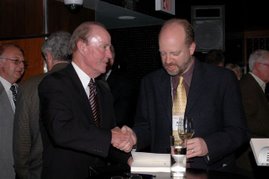
Former Social Credit Attorney-General Bud Smith, left, speaks to former Prime Minister Brian Mulroney, with Conservative government political aide Colin Metcalfe in centre and longtime Tory supporter and lawyer Lyall Knott at right.
At a Vancouver appearance Tuesday to launch his book Memoirs 1939-1993, Mulroney charmed a gathering that included a large part of his 1984 campaign team, as well as an impressive list of politicians, not all Conservatives.
After entering to a rousing ovation Mulroney quipped: "What the hell - why not another term?"
But Mulroney's most eloquent words were for former South African president Nelson Mandela, who has thanked the former PM for helping free him and his country from apartheid.
"South Africa was a vulgar and vile prison for 90 per cent of its population," Mulroney said.
The crowd included former provincial Social Credit cabinet ministers Grace McCarthy and Bud Smith and former Mulroney cabinet ministers Mary Collins and John Reynolds.
Current office-holders included Vancouver Mayor Sam Sullivan and councillor Peter Ladner, B.C. Liberal cabinet ministers John Les and Stan Hagen, B.C. Liberal MLA Ralph Sultan, Conservative MP James Moore, cabinet minister Gary Lunn and Senator Gerry St. Germain and even New Democrat MLA Bruce Ralston.
ADDITIONAL INFORMATION NOT PUBLISHED IN 24 HOURS
Also spotted at the Fraser Institute-sponsored event - the Pace Group's Norman Stowe, a longtime Conservative activist who remembered being in the same hotel in 1993 watching the disastrous federal election results that left the party with just two MPs and then-Prime Minister Kim Campbell with no seat.
Patrick Kinsella, BC Liberal fixer, racehorse owner and confidente to Premier Gordon Campbell was there, as was Greg D'Avignon, National Brewers President for western Canada, a former special assistant to Kim Campbell and more recently BC Liberal campaign manager to Virginia Greene in Vancouver-Fairview in the 2005 election. and Byng Giraud, a Conservative national councillor and senior consultant with Earnscliffe Strategy Group.
Additional Conservative pedigrees attending included Ray Castelli, Kim Campbell's former chief of staff and now President of Naikun Wind Development, an independent private power producer, and Lyall Knott, the powerful Tory operative most recently in the news for his past work for Francesco Aquilini in the controversial and court-contested acquisition of the Vancouver Canucks.
Other notables noticed were Tung Chan, CEO of S.U.C.C.E.S.S. immigrant services organization and former Non-Partisan Association Vancouver councilor, Peter Armstrong, CEO of Rocky Mountain Rail Tours and a huge BC Liberal Party financial donor, and John Aisenstat, a former Belinda Stronach campaign organizer when she ran for the Tory leadership who also ran John Reynolds 2004 election campaign.

Also attending were my 24 hours columnist colleagues Erin Airton and Alex Tsakumis, both Conservative activists in many campaigns, who were seen clutching Mulroney’s massive book, which weighs in at a 1152 pages!
The photo at left - and the copy of Mulroney's book I am holding - can both be credited to Colin Metcalfe.
Canaccord Capital chair Peter Brown - a friend of Brian Mulroney's since both were university students in the 1960s, sponsored the event for the Fraser Institute and told Mulroney: "Brian, you were probably the best friend the west ever had in Ottawa."
Mulroney told the crowd that Prime Minister Stephen Harper is doing a "fantastic" job.
Mulroney added that he told Harper recently: "That every prime minister has to learn humility. I didn't but all the rest did."
Mulroney also said that "the GST was entirely Michael Wilson's idea" to many laughs, and then added: "But I guess it doesn't matter now because Jean Chretien abolished it, didn't he?" to more applause.
The former prime minister listed what he saw as the many accomplishments of his government - the Free Trade Agreement, NAFTA, abolishing the National Energy Program of Pierre Trudeau, the Atlantic Accord and the Acid Rain Treaty, as well as reducing the deficit as a percentage of gross domestic product.
"In the fullness of time history will judge me," Mulroney said. "It is not a verdict I fear."
But Mulroney did not explain how with all these accomplishments, the Conservative Party was humiliated and nearly destroyed just months after he left office in the election campaign of 1993 under his successor Kim Campbell.
Wednesday, September 26, 2007
Former NDP senior aide John Heaney joins Heenan Blaikie, working with Peter Gall on management side labour relations files
New Democrats and labour leaders may be shocked to learn that John Heaney, a longtime senior aide in several NDP provincial governments and former BC Federation of Labour staff person has joined the law firm of Heenan Blaikie and is working with longtime management side lawyer Peter Gall on labour relations files.
John Heaney has replied to an email I sent inquiring about his work with Peter Gall and that response is included below in its entirety, as per his conditions for providing it.
Heaney is currently assisting Gall in representing the employer at the BC Human Rights Tribunal hearing on the case of foreign workers employed in construction of the Canada Line or Richmond-Airport-Vancouver Line who are alleging discrimination in wages based on racial origin.
SELI Canada hired a group of workers, predominantly from Costa Rica, to construct the tunnel and related infrastructure.
The workers complained to the Construction and Specialized Workers' Union Local 1611 that they were being paid less than BC's minimum wage despite promises of significantly higher wages when they were recruited, according to testimony at the BC Labour Relations Board. After the workers' situation was made public and reported in the media, their pay went up dramatically. The employer denies any wrongdoing.
The workers were subsequently certified but have not achieved a collective agreement and the LRB has yet to render decisions on several applications.
In the meantime they have filed a Human Rights Tribunal complaint. Gall has been representing SELI Canada at both the LRB and HRT; Heaney has appeared with Gall only at the HRT hearing this week. [I have worked with the BC and Yukon Building Trades Council and Local 1611 on the situation with the RAV Line workers from the beginning, I should note.]
Peter Gall is perhaps the most prominent management lawyer in BC and has represented employers in some of the most high profile cases in the province, most recently defending the BC Liberal government in the Supreme Court of Canada case over Bill 29, the legislation that allowed health employers to terminate thousands of unionized health care workers and privatize their jobs.
Gall has been active on employer side labour law since the 1980s and has also been credited in the BC Legislature for having helped draft Bill 19 - the Industrial Relations Act, draconian labour law passed by the Social Credit government of Bill Vander Zalm that led to a lengthy boycott of the Industrial Relations Council by BC Federation of Labour affiliates and other unions.
Gall has also been employer counsel on a large number of high profile union rights cases.
Everyone needs a job and certainly as a former worker representative on the Labour Relations Board I would never argue that employers do not deserve legal counsel that meets their needs. And as a consultant I work regularly with companies, but not on labour relations issues.
But the approach Gall has taken over many years is diametrically opposed to the interests of workers and their unions. That's his right and his decision.
It's very disappointing to me, though, that John Heaney, who has worked so closely and so long with unions and a New Democratic Party and government supported strongly by unionized workers would chose to work with Peter Gall and Heenan Blaikie to further the interests of employers, not workers.
John Heaney Response
Thank you for the opportunity to respond and for your commitment to publish it verbatim and in its entirety if you do post an item. My response is as follows:
You can call me proud and excited to be working at Heenan Blaikie’s office here in Victoria. We are Canada’s only national law firm with an office on Vancouver Island.
You can also say I am working to build a litigation practice. So far, I have clients here, in Vancouver and in the Interior. Just as I did at UVic’s poverty law clinic and in my two years with Joe Arvay as his co-op student and articling student, I will continue to represent a wide variety of people who need legal advice and advocacy. My clients will include employees and - like you, insofar as I’ve seen from your website – employers.
Working with the people at Heenan Blaikie is one of the best parts of the job. They are superb and I am thankful for the chance to work alongside them.
In the office next to me is our managing partner for Victoria, Joan Young. I think she is held in pretty high esteem by her peers as a savvy, experienced and successful litigator with irreproachable ethics. I’ve known Joan for almost 15 years and worked with her when she was an A.G. lawyer seconded to the Attorney General’s office as a legal advisor. She was later seconded to the Premier’s Office as legal counsel to the Premier. I don’t know if you ran into her during your time there, but she ably served the same Premier as you.
A bit further down the hall is Murray Rankin. I first started working with Murray in about 1993 when he wrote a report for the Harcourt government on the Kemano Completion Project. And I’ve been learning from him ever since. He is peer-rated as the public law lawyer that B.C. lawyers would most refer their clients to. Whether it’s privacy, FOI, aboriginal, resource, administrative or commercial law, Murray’s a nationally-ranked advocate and thinker and a much sought-after negotiator.
I am also really enjoying the chance to work with Peter Gall. I take it this is what you have a bee in your bonnet about. I think my first recollection of talking to Peter is when Mike Harcourt asked me to sort of ride herd on the process of severing some deputy ministers and other public servants the NDP terminated in its first year (ironically, including my now father-in-law).
I’m pretty sure Peter helped us with some of that. And I know for certain he remained a legal counsel to the NDP administration when it came to dealing with employment and labour relations - under Mike, Glen Clark and afterwards. Speaking of which, one of my first files at Heenan was from Peter - on behalf of a small company in the group Glen is responsible for. They seem to have been pretty happy with the help I gave them. I always thought Glen was a good guy and had the best mind of the few hundred politicians I’ve worked for. Still do. I take it from his picture on your website you may feel similarly.
While labour and employment are just part of my law practice, the files I’ve done with Peter Gall so far have shown me why he has received the highest-available peer ranking for ability and ethics in that field of law. A handful of lawyers practicing in the country have it.
I suppose you will probably trot out the names of Peter’s clients who weren’t the former NDP administration. So be it. I know his clients are very satisfied with his work, he has the respect of the people on all sides, and no one has ever suggested he practices law with anything but the highest level of ethics and integrity. Peter is also as bright a person as I’ve met and he is to labour law what Joe Arvay is to the constitution and civil liberties. Ask Joe. I’m pretty sure he would agree with all of the above.
So, while I cannot offer a remedy for your shock, I can tell you that in my 25th year as a New Democrat I am very proud of the work I did with four NDP premiers - and with Ken Georgetti and Angie Schira in that brief time you and I were co-workers at the BC Fed. I am just as proud to be Heenan Blaikie’s newest lawyer in BC.
Sincerely
John Heaney
John Heaney has replied to an email I sent inquiring about his work with Peter Gall and that response is included below in its entirety, as per his conditions for providing it.
Heaney is currently assisting Gall in representing the employer at the BC Human Rights Tribunal hearing on the case of foreign workers employed in construction of the Canada Line or Richmond-Airport-Vancouver Line who are alleging discrimination in wages based on racial origin.
SELI Canada hired a group of workers, predominantly from Costa Rica, to construct the tunnel and related infrastructure.
The workers complained to the Construction and Specialized Workers' Union Local 1611 that they were being paid less than BC's minimum wage despite promises of significantly higher wages when they were recruited, according to testimony at the BC Labour Relations Board. After the workers' situation was made public and reported in the media, their pay went up dramatically. The employer denies any wrongdoing.
The workers were subsequently certified but have not achieved a collective agreement and the LRB has yet to render decisions on several applications.
In the meantime they have filed a Human Rights Tribunal complaint. Gall has been representing SELI Canada at both the LRB and HRT; Heaney has appeared with Gall only at the HRT hearing this week. [I have worked with the BC and Yukon Building Trades Council and Local 1611 on the situation with the RAV Line workers from the beginning, I should note.]
Peter Gall is perhaps the most prominent management lawyer in BC and has represented employers in some of the most high profile cases in the province, most recently defending the BC Liberal government in the Supreme Court of Canada case over Bill 29, the legislation that allowed health employers to terminate thousands of unionized health care workers and privatize their jobs.
Gall has been active on employer side labour law since the 1980s and has also been credited in the BC Legislature for having helped draft Bill 19 - the Industrial Relations Act, draconian labour law passed by the Social Credit government of Bill Vander Zalm that led to a lengthy boycott of the Industrial Relations Council by BC Federation of Labour affiliates and other unions.
Gall has also been employer counsel on a large number of high profile union rights cases.
Everyone needs a job and certainly as a former worker representative on the Labour Relations Board I would never argue that employers do not deserve legal counsel that meets their needs. And as a consultant I work regularly with companies, but not on labour relations issues.
But the approach Gall has taken over many years is diametrically opposed to the interests of workers and their unions. That's his right and his decision.
It's very disappointing to me, though, that John Heaney, who has worked so closely and so long with unions and a New Democratic Party and government supported strongly by unionized workers would chose to work with Peter Gall and Heenan Blaikie to further the interests of employers, not workers.
John Heaney Response
Thank you for the opportunity to respond and for your commitment to publish it verbatim and in its entirety if you do post an item. My response is as follows:
You can call me proud and excited to be working at Heenan Blaikie’s office here in Victoria. We are Canada’s only national law firm with an office on Vancouver Island.
You can also say I am working to build a litigation practice. So far, I have clients here, in Vancouver and in the Interior. Just as I did at UVic’s poverty law clinic and in my two years with Joe Arvay as his co-op student and articling student, I will continue to represent a wide variety of people who need legal advice and advocacy. My clients will include employees and - like you, insofar as I’ve seen from your website – employers.
Working with the people at Heenan Blaikie is one of the best parts of the job. They are superb and I am thankful for the chance to work alongside them.
In the office next to me is our managing partner for Victoria, Joan Young. I think she is held in pretty high esteem by her peers as a savvy, experienced and successful litigator with irreproachable ethics. I’ve known Joan for almost 15 years and worked with her when she was an A.G. lawyer seconded to the Attorney General’s office as a legal advisor. She was later seconded to the Premier’s Office as legal counsel to the Premier. I don’t know if you ran into her during your time there, but she ably served the same Premier as you.
A bit further down the hall is Murray Rankin. I first started working with Murray in about 1993 when he wrote a report for the Harcourt government on the Kemano Completion Project. And I’ve been learning from him ever since. He is peer-rated as the public law lawyer that B.C. lawyers would most refer their clients to. Whether it’s privacy, FOI, aboriginal, resource, administrative or commercial law, Murray’s a nationally-ranked advocate and thinker and a much sought-after negotiator.
I am also really enjoying the chance to work with Peter Gall. I take it this is what you have a bee in your bonnet about. I think my first recollection of talking to Peter is when Mike Harcourt asked me to sort of ride herd on the process of severing some deputy ministers and other public servants the NDP terminated in its first year (ironically, including my now father-in-law).
I’m pretty sure Peter helped us with some of that. And I know for certain he remained a legal counsel to the NDP administration when it came to dealing with employment and labour relations - under Mike, Glen Clark and afterwards. Speaking of which, one of my first files at Heenan was from Peter - on behalf of a small company in the group Glen is responsible for. They seem to have been pretty happy with the help I gave them. I always thought Glen was a good guy and had the best mind of the few hundred politicians I’ve worked for. Still do. I take it from his picture on your website you may feel similarly.
While labour and employment are just part of my law practice, the files I’ve done with Peter Gall so far have shown me why he has received the highest-available peer ranking for ability and ethics in that field of law. A handful of lawyers practicing in the country have it.
I suppose you will probably trot out the names of Peter’s clients who weren’t the former NDP administration. So be it. I know his clients are very satisfied with his work, he has the respect of the people on all sides, and no one has ever suggested he practices law with anything but the highest level of ethics and integrity. Peter is also as bright a person as I’ve met and he is to labour law what Joe Arvay is to the constitution and civil liberties. Ask Joe. I’m pretty sure he would agree with all of the above.
So, while I cannot offer a remedy for your shock, I can tell you that in my 25th year as a New Democrat I am very proud of the work I did with four NDP premiers - and with Ken Georgetti and Angie Schira in that brief time you and I were co-workers at the BC Fed. I am just as proud to be Heenan Blaikie’s newest lawyer in BC.
Sincerely
John Heaney
Tuesday, September 25, 2007
BC Liberals attempt outrageous gerrymandering by intervening with BC Electoral Boundaries Commission
Bill Tieleman’s 24 Hours Column
Tuesday September 25, 2007
Gerrymandering Gord must stop
By BILL TIELEMAN
Gerrymander now means to divide a voting district in such a way as to give unfair advantage to one political party.
Imagine a place where the political leader overrules an independent commission report on electoral boundaries.
Imagine that leader orders more ridings be created in areas where his governing party is strongest and opposition weakest to win more seats in the next election.
Imagine a place where the vote of a person in an opposition riding is worth just a fraction of the vote of a person in a government riding.
Zimbabwe under Robert Mugabe perhaps?
No. Try British Columbia under Premier Gordon Campbell.
Voters should be screaming blue bloody murder about Campbell's outrageous gerrymandering - intervening in an independent process to determine B.C's electoral boundaries to demand extra ridings that are clearly to the advantage of his own political party.
And all the while, Campbell piously claims to be "protecting" rural ridings.
More like protecting his own posterior. In fact, Campbell will actually dilute the influence of rural ridings by adding more Members of the Legislative Assembly in urban areas where his B.C. Liberal Party is strongest.
The independent B.C. Electoral Boundaries Commission did an admirable job redistributing ridings fairly and in keeping with the fundamental democratic principle of representation by population.
The commission's report angered some rural areas because it would have added just two seats in total to the Legislature while eliminating three seats in places like Prince George, where population is declining.
But Campbell has used that rural anger to attempt one of the most daring and scandalous gerrymanders B.C. has ever seen.
The Electoral Boundaries Commission Act is clear that in sparsely populated areas "very special circumstances" allow the commission to exceed the plus or minus 25 per cent deviation in population per riding.
So a few rural ridings can have a lot less voters than an urban riding - fair enough.
The commission determined that despite allowing two ridings significant deviations of 53 per cent and 54 per cent over the average, some ridings would have to be combined.
But instead of letting the independent commission to do its job, Campbell has ordered it to keep the existing seats in those areas and add five new seats in "growing regions" - regions where the Liberals are strongest.
Why should Education Minister Shirley Bond be elected in Prince George-Mount Robson with 34,968 people, while NDP opposition MLA Jagrup Brar is elected in Surrey-Panorama Ridge with 64,890 people? Both members have one vote in the legislature but Brar represents 30,000 more voters!
There's no perfect solution to fairly distributing ridings but one thing is clear - Campbell's overruling an independent commission to add seats in Liberal areas is the worst kind of gerrymandering - and must be stopped.
Tuesday September 25, 2007
Gerrymandering Gord must stop
By BILL TIELEMAN
Gerrymander now means to divide a voting district in such a way as to give unfair advantage to one political party.
- Phyllis Martin, Quips, Quotes and Savvy Sayings
Imagine a place where the political leader overrules an independent commission report on electoral boundaries.
Imagine that leader orders more ridings be created in areas where his governing party is strongest and opposition weakest to win more seats in the next election.
Imagine a place where the vote of a person in an opposition riding is worth just a fraction of the vote of a person in a government riding.
Zimbabwe under Robert Mugabe perhaps?
No. Try British Columbia under Premier Gordon Campbell.
Voters should be screaming blue bloody murder about Campbell's outrageous gerrymandering - intervening in an independent process to determine B.C's electoral boundaries to demand extra ridings that are clearly to the advantage of his own political party.
And all the while, Campbell piously claims to be "protecting" rural ridings.
More like protecting his own posterior. In fact, Campbell will actually dilute the influence of rural ridings by adding more Members of the Legislative Assembly in urban areas where his B.C. Liberal Party is strongest.
The independent B.C. Electoral Boundaries Commission did an admirable job redistributing ridings fairly and in keeping with the fundamental democratic principle of representation by population.
The commission's report angered some rural areas because it would have added just two seats in total to the Legislature while eliminating three seats in places like Prince George, where population is declining.
But Campbell has used that rural anger to attempt one of the most daring and scandalous gerrymanders B.C. has ever seen.
The Electoral Boundaries Commission Act is clear that in sparsely populated areas "very special circumstances" allow the commission to exceed the plus or minus 25 per cent deviation in population per riding.
So a few rural ridings can have a lot less voters than an urban riding - fair enough.
The commission determined that despite allowing two ridings significant deviations of 53 per cent and 54 per cent over the average, some ridings would have to be combined.
But instead of letting the independent commission to do its job, Campbell has ordered it to keep the existing seats in those areas and add five new seats in "growing regions" - regions where the Liberals are strongest.
Why should Education Minister Shirley Bond be elected in Prince George-Mount Robson with 34,968 people, while NDP opposition MLA Jagrup Brar is elected in Surrey-Panorama Ridge with 64,890 people? Both members have one vote in the legislature but Brar represents 30,000 more voters!
There's no perfect solution to fairly distributing ridings but one thing is clear - Campbell's overruling an independent commission to add seats in Liberal areas is the worst kind of gerrymandering - and must be stopped.
Sunday, September 23, 2007
Will Gordon Campbell announce 1000 new "non-market" housing units in Vancouver at UBCM?
Reliable sources indicate that BC Premier Gordon Campbell may announce the province is funding creation of 1000 new "non-market" Vancouver housing units at this week's Union of BC Municipalities conference.
The move would shore up a vulnerability on housing issues after the embarrassing claim that the February 2007 budget was a "housing" budget - merely because Finance Minister Carole Taylor said tax cuts in the budget would allow people to spend income they saved on housing.
To Taylor and the BC Liberals that somehow amounted to a $2 billion housing plan, a completely bogus boast that was soon jettisoned.
But this announcement, if it comes true, could be a real attempt at some form of social housing for those in need in the downtown core.
It would also come after the surprise announcement in April of this year that the province was buying up 11 residential Single Room Occupancy hotels - 10 in Vancouver and one in Victoria - in a move that stunned poverty advocates.
With a substantial budget surplus, the BC Liberals can well afford to create housing units - a move that would also further frustrate their New Democrat opposition.
The BC Liberals effort to reposition themselves as a centrist, fiscally conservative but social conscious party and government appears to be continuing, a dramatic change from the hard-right, slash and burn approach Campbell took in his first term.
1000 new non-market housing units from the province would also be of immense relief to beleaguered Vancouver Mayor Sam Sullivan, who needs some success to point to for his efforts.
The move would shore up a vulnerability on housing issues after the embarrassing claim that the February 2007 budget was a "housing" budget - merely because Finance Minister Carole Taylor said tax cuts in the budget would allow people to spend income they saved on housing.
To Taylor and the BC Liberals that somehow amounted to a $2 billion housing plan, a completely bogus boast that was soon jettisoned.
But this announcement, if it comes true, could be a real attempt at some form of social housing for those in need in the downtown core.
It would also come after the surprise announcement in April of this year that the province was buying up 11 residential Single Room Occupancy hotels - 10 in Vancouver and one in Victoria - in a move that stunned poverty advocates.
With a substantial budget surplus, the BC Liberals can well afford to create housing units - a move that would also further frustrate their New Democrat opposition.
The BC Liberals effort to reposition themselves as a centrist, fiscally conservative but social conscious party and government appears to be continuing, a dramatic change from the hard-right, slash and burn approach Campbell took in his first term.
1000 new non-market housing units from the province would also be of immense relief to beleaguered Vancouver Mayor Sam Sullivan, who needs some success to point to for his efforts.
Friday, September 21, 2007
Will Gordon "green" Gateway with Evergreen Line realignment? Can BC Liberals grow Astroturf?
A Bridge Too Far? Rumours swirl of Gordon Campbell Gateway repositioning with Evergreen Line realignment over Port Mann to counter greenhouse gas increases
Meanwhile BC Liberal Astroturf group continues to sprout nonsense
The controversial Gateway project that will increase greenhouse gases may be in line for some greenwashing by Premier Gordon Campbell.
Rumours first reported by Gordon Price indicate that the Evergreen Line - long-planned but never implemented - may be funded and realigned to include a branch spanning the Port Mann bridge.
The intent is to blunt strong criticism of Gateway and in particular that the twinning of the Port Mann bridge that will put thousands more cars on the road - and according to Metro Vancouver [formerly GVRD] report, add significantly to greenhouse gas emissions.
"Traffic-related greenhouse-gas emissions with the Gateway Program will be 2.1 per cent (approximately 176,000 tonnes) higher in 2021, as compared to a 'without Gateway' scenario," said the report.
That's a problem, as Campbell has recently stated BC's goal will be to reduce greenhouse gas emissions by 33 per cent by 2020, an amount that many experts feel will be extremely hard to achieve.
Price, a six-time Non-Partisan Association councilor and longtime sustainability advocate, says that an announcement on the Evergreen Line could come as soon as the Union of BC Municipalities conference next week.
"Regarding the Evergreen Line, a mayor of an eastern municipality is convinced an announcement is coming soon. Perhaps at the UBCM. The mayor also thinks that the Evergreen Line will take the southwest route along Lougheed AND a branch will head off over the Port Mann to Guildford (maybe further)," Price writes on his blog.
Meanwhile, a BC Liberal Astroturf group continues to sprout nonsense.
Get Moving BC, a group closely connected to key BC Liberals in the South Fraser, released a poll claiming that 72% of Burnaby residents support the Gateway program. Surprise, surprise, Burnaby city council has consistently opposed Gateway!
So it is equally surprising to find that among those involved in Get Moving BC are: Jordan Bateman, vice-president of Forestry Minister Rich Coleman's riding association and a Langley Township councillor; Greg Moore, former BC Liberal candiate,Port Coquitlam city councillor and currently BC Liberal organizer; Brian Bonney, former operations director for the BC Liberals; and Patrick O'Connor, a BC Liberal supporter who is Get Moving spokesman.
Burnaby Mayor Derek Corrigan told the Province newspaper that the poll was "laughable".
Don't know about the poll but the group is certainly worth a chuckle.
Meanwhile BC Liberal Astroturf group continues to sprout nonsense
The controversial Gateway project that will increase greenhouse gases may be in line for some greenwashing by Premier Gordon Campbell.
Rumours first reported by Gordon Price indicate that the Evergreen Line - long-planned but never implemented - may be funded and realigned to include a branch spanning the Port Mann bridge.
The intent is to blunt strong criticism of Gateway and in particular that the twinning of the Port Mann bridge that will put thousands more cars on the road - and according to Metro Vancouver [formerly GVRD] report, add significantly to greenhouse gas emissions.
"Traffic-related greenhouse-gas emissions with the Gateway Program will be 2.1 per cent (approximately 176,000 tonnes) higher in 2021, as compared to a 'without Gateway' scenario," said the report.
That's a problem, as Campbell has recently stated BC's goal will be to reduce greenhouse gas emissions by 33 per cent by 2020, an amount that many experts feel will be extremely hard to achieve.
Price, a six-time Non-Partisan Association councilor and longtime sustainability advocate, says that an announcement on the Evergreen Line could come as soon as the Union of BC Municipalities conference next week.
"Regarding the Evergreen Line, a mayor of an eastern municipality is convinced an announcement is coming soon. Perhaps at the UBCM. The mayor also thinks that the Evergreen Line will take the southwest route along Lougheed AND a branch will head off over the Port Mann to Guildford (maybe further)," Price writes on his blog.
Meanwhile, a BC Liberal Astroturf group continues to sprout nonsense.
Get Moving BC, a group closely connected to key BC Liberals in the South Fraser, released a poll claiming that 72% of Burnaby residents support the Gateway program. Surprise, surprise, Burnaby city council has consistently opposed Gateway!
So it is equally surprising to find that among those involved in Get Moving BC are: Jordan Bateman, vice-president of Forestry Minister Rich Coleman's riding association and a Langley Township councillor; Greg Moore, former BC Liberal candiate,Port Coquitlam city councillor and currently BC Liberal organizer; Brian Bonney, former operations director for the BC Liberals; and Patrick O'Connor, a BC Liberal supporter who is Get Moving spokesman.
Burnaby Mayor Derek Corrigan told the Province newspaper that the poll was "laughable".
Don't know about the poll but the group is certainly worth a chuckle.
Thursday, September 20, 2007
Ipsos Poll Detailed Results Not Good News for BC NDP
The latest Ipsos poll on BC politics has been presented as a "no change" story, with the BC Liberals continuing at the same level as previously, 46% to the BC NDP's 36% - a significant but not insurmountable 10 point gap. The leaderless Green Party polls at 15%.
However, a look at the Ipsos detailed tables uncovers some bigger problems for the BC NDP.
In the breakdown for the Lower Mainland, the Liberal lead grows to 49% to 34% for the NDP, and the sample size of 411 surveyed makes it statistically decent. A 15 point gap is enormous and would spell deep trouble for Vancouver, Surrey and Burnaby NDP MLAs if an election were held today.
The Greens hold 14% in the Lower Mainland.
In the Interior the Liberals lead 45% to 33% NDP, with the Greens at 16%. The smaller sample size of 152 is less reliable.
Only on Vancouver Island do the NDP best the Liberals, with a 46% NDP to 36% Liberal score, with the Greens at 17%. A small sample of 88 is even less statistically dependable, however.
In other demographic breakdowns, the Liberals lead in almost every category, including males 50% to 32%, females 42% to 40%, age 55+ by 51% to 37%, 35-54 year olds by 47% to 37% and 18-34 year olds by 37% to 35%.
In other education and income categories, the NDP only leads in the under $40,000 group, by 38% to 30% for the Liberals.
None of these factors are insurmountable but the challenge facing the BC NDP and leader Carole James is considerable to overcome the substantial lead the BC Liberals and Gordon Campbell hold within many different demographic subsets.
However, a look at the Ipsos detailed tables uncovers some bigger problems for the BC NDP.
In the breakdown for the Lower Mainland, the Liberal lead grows to 49% to 34% for the NDP, and the sample size of 411 surveyed makes it statistically decent. A 15 point gap is enormous and would spell deep trouble for Vancouver, Surrey and Burnaby NDP MLAs if an election were held today.
The Greens hold 14% in the Lower Mainland.
In the Interior the Liberals lead 45% to 33% NDP, with the Greens at 16%. The smaller sample size of 152 is less reliable.
Only on Vancouver Island do the NDP best the Liberals, with a 46% NDP to 36% Liberal score, with the Greens at 17%. A small sample of 88 is even less statistically dependable, however.
In other demographic breakdowns, the Liberals lead in almost every category, including males 50% to 32%, females 42% to 40%, age 55+ by 51% to 37%, 35-54 year olds by 47% to 37% and 18-34 year olds by 37% to 35%.
In other education and income categories, the NDP only leads in the under $40,000 group, by 38% to 30% for the Liberals.
None of these factors are insurmountable but the challenge facing the BC NDP and leader Carole James is considerable to overcome the substantial lead the BC Liberals and Gordon Campbell hold within many different demographic subsets.
Tuesday, September 18, 2007
Carole James should have thanked MLA Michael Sather, not thrown him out of caucus over Tsawwassen Treaty opposition
Bill Tieleman’s 24 Hours Column
Tuesday September 18, 2007
Green trouble for NDP's James
By BILL TIELEMAN
Burn down your cities and leave our farms, and your cities will spring up again as if by magic; but destroy our farms and the grass will grow in the streets of every city in the country.
Carole James owes MLA Michael Sather a huge debt of gratitude.
But instead of thanking him, the B.C. New Democratic Party leader has thrown Sather out of her caucus!
Sather's offence? The Maple Ridge-Pitt Meadows MLA is simply supporting a long-cherished NDP policy to protect valuable and disappearing farmland from industrial and residential development.
Sather's real problem is that he refuses to accept the wrongheaded idea that farmland is only worth protecting unless aboriginal people want to pave it and sell it to park shipping containers destined to and from China.
That means he will vote against the Tsawwassen First Nation treaty - only because the B.C. Liberals exempted the TFN from the provisions of the Agricultural Land Reserve, the historic legislation brought in by Dave Barrett's first NDP government in 1973.
And because James said the NDP caucus supports the treaty, she expelled Sather this month.
But James should instead be thanking Sather for opposing the treaty that removes 207 hectares of farmland from ALR protection and gives it to the Tsawwassen for Deltaport expansion.
That's because Sather is the thin red line holding back NDP voters who are environmental and farmland supporters from giving up on the party and voting Green.
Sather, along with NDP MLAs Guy Gentner, Corky Evans and possibly others who will abstain rather than vote for a treaty that will permanently eliminate a huge tract of productive farmland, is defending one of the NDP's proudest accomplishments.
And by doing so Sather is assuring NDP voters that protecting farms is worth fighting for to some in the party.
With the NDP at 32 per cent support, miles behind the B.C. Liberals at 50 per cent, and with the Green Party at 16 per cent in the latest Mustel Group poll, Carole James is in big trouble.
Two Green Party leadership candidates, Ben West and Damian Kettlewell, say they oppose the treaty over the ALR exemption.
That leaves Sather to defend farmland for the NDP.
"The issue of preserving agricultural land is so essential, whether it's protecting our food supply or climate change, it's so important," Sather said in an interview.
James has also alienated voters who believe - rightly - that an elected MLA is their representative, not simply a political party's. But the NDP provincial council backed James' position against a free vote - something B.C. Liberals MLAs will have.
"I am disappointed - we should have a free vote," Sather says.
And disappointment with the B.C. NDP is becoming James' biggest problem of all.
ADDITIONAL INFORMATION NOT PUBLISHED IN 24 HOURS
The Western Canada Wilderness Committee has also supported Sather and his call for a free vote on the Tsawwassen Treaty.
“We consider MLA Michael Sather to be a thoughtful, courageous, and well-spoken proponent for protecting BCs farmland...There are British Columbians who are not in favour of a treaty settlement that would see farmland paved and we would hope that these views could be represented by elected representatives without censure," said Joe Foy, Wilderness Committee National Campaign Director.
"The suspension of Mr. Sather from the NDP caucus and the continuing pressure to prevent a free vote on this important issue is, in our opinion, an assault on the free debate of important issues that a robust democracy depends on,” Foy added.
In a letter to NDP leader Carole James, the WCWC asks her to reconsider the position taken against a free vote on the treaty.
"The Wilderness Committee is extremely appreciative of NDP MLAs Michael Sather (Maple Ridge-Pitt Meadows) Corky Evans (Nelson-Creston) and Guy Gentner (Delta North) for speaking out against the proposed treaty and for speaking up for the protection of farmland, the environment and community health," Foy wrote.
"We are therefore very dismayed to learn that all NDP MLAs are expected by you to vote for the treaty - no exceptions - in order to show party solidarity on this issue."
"Media reports also indicate that NDP MLAs that still choose to vote against the proposed treaty will suffer some kind of sanctions and this has us especially concerned. I note that the governing Liberals are allowing a free vote amongst their MLAs."
"Please, won't you reconsider?"
Tuesday September 18, 2007
Green trouble for NDP's James
By BILL TIELEMAN
Burn down your cities and leave our farms, and your cities will spring up again as if by magic; but destroy our farms and the grass will grow in the streets of every city in the country.
- William Jennings Bryan, 1860-1925
Carole James owes MLA Michael Sather a huge debt of gratitude.
But instead of thanking him, the B.C. New Democratic Party leader has thrown Sather out of her caucus!
Sather's offence? The Maple Ridge-Pitt Meadows MLA is simply supporting a long-cherished NDP policy to protect valuable and disappearing farmland from industrial and residential development.
Sather's real problem is that he refuses to accept the wrongheaded idea that farmland is only worth protecting unless aboriginal people want to pave it and sell it to park shipping containers destined to and from China.
That means he will vote against the Tsawwassen First Nation treaty - only because the B.C. Liberals exempted the TFN from the provisions of the Agricultural Land Reserve, the historic legislation brought in by Dave Barrett's first NDP government in 1973.
And because James said the NDP caucus supports the treaty, she expelled Sather this month.
But James should instead be thanking Sather for opposing the treaty that removes 207 hectares of farmland from ALR protection and gives it to the Tsawwassen for Deltaport expansion.
That's because Sather is the thin red line holding back NDP voters who are environmental and farmland supporters from giving up on the party and voting Green.
Sather, along with NDP MLAs Guy Gentner, Corky Evans and possibly others who will abstain rather than vote for a treaty that will permanently eliminate a huge tract of productive farmland, is defending one of the NDP's proudest accomplishments.
And by doing so Sather is assuring NDP voters that protecting farms is worth fighting for to some in the party.
With the NDP at 32 per cent support, miles behind the B.C. Liberals at 50 per cent, and with the Green Party at 16 per cent in the latest Mustel Group poll, Carole James is in big trouble.
Two Green Party leadership candidates, Ben West and Damian Kettlewell, say they oppose the treaty over the ALR exemption.
That leaves Sather to defend farmland for the NDP.
"The issue of preserving agricultural land is so essential, whether it's protecting our food supply or climate change, it's so important," Sather said in an interview.
James has also alienated voters who believe - rightly - that an elected MLA is their representative, not simply a political party's. But the NDP provincial council backed James' position against a free vote - something B.C. Liberals MLAs will have.
"I am disappointed - we should have a free vote," Sather says.
And disappointment with the B.C. NDP is becoming James' biggest problem of all.
ADDITIONAL INFORMATION NOT PUBLISHED IN 24 HOURS
The Western Canada Wilderness Committee has also supported Sather and his call for a free vote on the Tsawwassen Treaty.
“We consider MLA Michael Sather to be a thoughtful, courageous, and well-spoken proponent for protecting BCs farmland...There are British Columbians who are not in favour of a treaty settlement that would see farmland paved and we would hope that these views could be represented by elected representatives without censure," said Joe Foy, Wilderness Committee National Campaign Director.
"The suspension of Mr. Sather from the NDP caucus and the continuing pressure to prevent a free vote on this important issue is, in our opinion, an assault on the free debate of important issues that a robust democracy depends on,” Foy added.
In a letter to NDP leader Carole James, the WCWC asks her to reconsider the position taken against a free vote on the treaty.
"The Wilderness Committee is extremely appreciative of NDP MLAs Michael Sather (Maple Ridge-Pitt Meadows) Corky Evans (Nelson-Creston) and Guy Gentner (Delta North) for speaking out against the proposed treaty and for speaking up for the protection of farmland, the environment and community health," Foy wrote.
"We are therefore very dismayed to learn that all NDP MLAs are expected by you to vote for the treaty - no exceptions - in order to show party solidarity on this issue."
"Media reports also indicate that NDP MLAs that still choose to vote against the proposed treaty will suffer some kind of sanctions and this has us especially concerned. I note that the governing Liberals are allowing a free vote amongst their MLAs."
"Please, won't you reconsider?"
Sunday, September 16, 2007
Single Transferable Vote proposal for BC would be a disaster, electoral maps show
Bill Tieleman’s 24 Hours Column
Tuesday August 28, 2007
The stupidity of single transfer
By BILL TIELEMAN
The great thing about democracy is that it gives every voter a chance to do something stupid.
Imagine an electoral voting system so complicated, so disliked and so obscure that only two countries in the world - both tiny islands - use it for their national elections.
Imagine British Columbia following in the footsteps of Malta and Ireland.
And imagine a system where all of B.C. would have just 20 giant electoral districts instead of the current 79, with up to six members of the Legislative Assembly per riding.
Then imagine that B.C. voters might seriously adopt it for our own elections.
Stupid? You bet, but B.C. will decide on whether to adopt the single transferable vote or STV system in a May 12, 2009 referendum run concurrent with the next provincial election.
B.C. voters didn't think enough of STV in the 2005 referendum to give the required 60 per cent approval to implement this bad idea, suggested by the Citizens Assembly. Unfortunately, it came close enough that Premier Gordon Campbell is holding a second referendum.
But fortunately, the B.C. Electoral Boundaries Commission has provided what was missing in the last referendum - an STV riding map so every voter can see exactly what STV would look like.
It's not a pretty picture. In fact, it should be enough evidence for anyone who cares about how we vote to flatly reject it.
For example, Ireland is a small place with a population of four million people. Yet Ireland under STV has 166 elected representatives spread over 70,000 square kilometres.
B.C. has 4.3 million people but is a large province of 948,000 square kilometres and under STV, B.C. would have 81 MLAs.
That means on average an Irish politician represents an area of 422 square kilometres while under STV on average a B.C. politician would represent an area of 11,703 square kilometres.
Stupid.
Now, of course, those are only averages and in Vancouver and other urban centres riding sizes under STV would be much smaller.
But that also means under STV northern and interior ridings would be positively enormous.
Take the proposed B.C. STV riding of Northeast. It would have two MLAs and a size of - wait for it - 274,752 square kilometres! That means just one riding with two MLAs is nearly four times bigger than all of Ireland with its 166 members!
And the new riding map shows several other gigantic ridings that are simply unmanageable for MLAs.
Of course, STV advocates dare not suggest doubling our legislature to 166 members but it's obvious that STV just doesn't work for large geographic areas.
There's much more wrong with STV and I will write about it in the months ahead of the referendum.
Meanwhile, I am on vacation - back on Tuesday, Sept. 18.
Tuesday August 28, 2007
The stupidity of single transfer
By BILL TIELEMAN
The great thing about democracy is that it gives every voter a chance to do something stupid.
- Journalist Art Spander
Imagine an electoral voting system so complicated, so disliked and so obscure that only two countries in the world - both tiny islands - use it for their national elections.
Imagine British Columbia following in the footsteps of Malta and Ireland.
And imagine a system where all of B.C. would have just 20 giant electoral districts instead of the current 79, with up to six members of the Legislative Assembly per riding.
Then imagine that B.C. voters might seriously adopt it for our own elections.
Stupid? You bet, but B.C. will decide on whether to adopt the single transferable vote or STV system in a May 12, 2009 referendum run concurrent with the next provincial election.
B.C. voters didn't think enough of STV in the 2005 referendum to give the required 60 per cent approval to implement this bad idea, suggested by the Citizens Assembly. Unfortunately, it came close enough that Premier Gordon Campbell is holding a second referendum.
But fortunately, the B.C. Electoral Boundaries Commission has provided what was missing in the last referendum - an STV riding map so every voter can see exactly what STV would look like.
It's not a pretty picture. In fact, it should be enough evidence for anyone who cares about how we vote to flatly reject it.
For example, Ireland is a small place with a population of four million people. Yet Ireland under STV has 166 elected representatives spread over 70,000 square kilometres.
B.C. has 4.3 million people but is a large province of 948,000 square kilometres and under STV, B.C. would have 81 MLAs.
That means on average an Irish politician represents an area of 422 square kilometres while under STV on average a B.C. politician would represent an area of 11,703 square kilometres.
Stupid.
Now, of course, those are only averages and in Vancouver and other urban centres riding sizes under STV would be much smaller.
But that also means under STV northern and interior ridings would be positively enormous.
Take the proposed B.C. STV riding of Northeast. It would have two MLAs and a size of - wait for it - 274,752 square kilometres! That means just one riding with two MLAs is nearly four times bigger than all of Ireland with its 166 members!
And the new riding map shows several other gigantic ridings that are simply unmanageable for MLAs.
Of course, STV advocates dare not suggest doubling our legislature to 166 members but it's obvious that STV just doesn't work for large geographic areas.
There's much more wrong with STV and I will write about it in the months ahead of the referendum.
Meanwhile, I am on vacation - back on Tuesday, Sept. 18.
Subscribe to:
Posts (Atom)